
Wednesday, 19 March 2014

Weather tables?! I don’t need no steenking weather tables!


I love weather tables.

Wait, what?! What about the title of this post?

Let me explain. I love weather tables. I love the way in which they can succinctly, and without the confusion of poorly written prose, tell a Referee about the types and frequencies of weather that a region (a region that might be quite alien to our 'real world' knowledge) might experience in any given season. But I don't roll on them. At least not when I am playing a D&Dish game, or a game that aspires to the abstraction of Basic/Expert D&D - as my current rules melange tends towards, combining a D100 game (Magic World with bits and bobs from the rest of the 'family'), but bolting on the Mentzer D&D wilderness exploration rules (and the reaction table, and morale rules, etc).

I don't roll on weather tables because, in this type of game, weather only really matters when it is going to have a game effect. I might describe the weather, based on the region and the season. And sure, if we were playing a very crunchy game we might have mechanics where spring shower might hinder the PCs' ability to use their bows, risk ruining a spell book, and so on, but D&D is a game of abstractions. And in Basic/Expert D&D I have a roll that abstracts the game effects of the weather – the roll for ‘getting lost’.

I used to puzzle over the roll for getting lost. How on Mystara should a party of adventurers get lost so often? I didn't understand how to apply the getting lost rule because I was living with all the privileges of a 20th/21st century citizen of the 'West' and I have never been particularly 'outdoorsy'. But getting *dangerously* lost in even the limited 'wilds' of the UK is perfectly possible, and pretty common, even in an age of advanced meteorology, mobile phones, superb cartography, GPS devices, fantastically weather-resistant clothing, etc.

In Mentzer D&D, a party will become lost once every six days of travel in 'Clear or Grassland' terrain, every other day when travelling in 'Swamp, Jungle, or Desert', and once every three days in 'All Other'. In the books, there isn't much guidance to lead a Referee to use the rule in a way that is any more interesting than the party setting off in the wrong direction after breaking camp. 

But the vast majority of D&D rules are like that, from reaction rolls, to combat, to morale, to wandering monsters. You are provided with a short cut to a game effect, and it is the job of the Referee to rationalise and describe that effect in ways that are interesting both descriptively, and that lead to further opportunities for the players to make decisions for their PCs. So, sure, the PCs might simply veer off course, but in the abstraction of D&D, I have come to use the ‘getting lost’ roll as and an ‘environmental encounter’, or, more interestingly ‘travel obstacle’ roll. 

So, when crossing a Grassland, if the Referee rolls a '1', it might simply be a particularly overcast day, causing the party to lose their bearings when trying to navigate by the Sun. It might have be a spring shower, that leads to their cart (you do use encumbrance rules, yes?) getting stuck in the mud. It might have be a minor river swollen by spring rain and meltwater from the highlands, that appears too dangerous to ford (though the party can try their luck... if they don't want to deviate from their path). The party might be using a functionally poor map, with landmarks misplaced, making navigation confusing. There might be a bushfire ahead. In mountains the travel obstacle might be even quite mild weather. It might be a ravine, a rockfall, cliff face. And so on. Or the party might come across an 'encounter' that seriously tempts them to delay or deviate in their travel. I suggest that a 'getting lost' roll used to throw an encounter the PCs way should be peaceful (at least initially) encounters - things designed to delay and divert the PCs, distinct from the direct dangers that I reserve for the wandering 'monster' tables. So, a village reduced to smoking ruins for the PCs to pick through. A caravan of traders. A column of refugees. Or pilgrims. Lost children. A leper colony. An opportunity to hunt a magnificent stag.


In other words, I use the getting lost roll, with a 'lost' result indicating that something has disrupted, or has the potential to disrupt their planned journey. And because of this I ignore the guidance that getting lost rolls should not be made on roads, or rivers, or when following a coastline. Sure, the PCs are less likely to actually get lost. But when following a road (say), the PCs are far more likely to encounter 'peaceful' delays and diversions - so it all balances out in the abstraction of D&D. While a 1 rolled when crossing a Grassland might be a day's delay as the party veers off course, on a road it is the potential for a day to be lost dealing with an interesting NPC (or taking the consequences of refusing to engage with the NPC). Or it is simply a broken wheel on the cart, leading to a decision the players need to make balancing the urgency of their travel and the need for all that gear they are lugging around.

I am ambivalent about whether I need to build random tables for 'travel obstacles'. I haven't as yet, and think that the variety required - terrain, season, level of civilization, etc. - might make it a fool's errand. And then we have the problem that a 'travel obstacle' is not the same for one party as it is another. These are the problems, not that that some of the encounters briefly described above are 'unique' is not a problem. I use wandering monster tables - I think the 'mechanisation' of the presence of active dangers by region/terrain is a useful thing - and while my encounter tables sometimes have 'unique' encounters baked into them, there is plenty of generic encounters too (and must be if you are accommodating player freedom without burning yourself out on preparation). But when I roll up some Orcs, the encounter is not just 2d4 Orcs appear 4d6x10 yards away. Fight! These random rolls provide the bones for making an encounter unique. 2 Orcs appearing 40 yards away presents different opportunities for Referee rationalisation than does 8 Orcs appearing 240 yards away. And then the reaction table provides another bone for the skeleton. Could we (I) build a series of analogous rolls that would add a few bones to the 'travel obstacle', allowing Referee interpretation and improvisation, without needing a huge list of unique encounters, or something as big as one of the Books of the Tome of Adventure Design?  

Anyway, I've got diverted, slowly slipping into a broader discussion of my admiration of D&D as a 'procedural' game...

Monday, 3 March 2014

Melange


Not something collected from Sand Worms, but a description of the patchwork of rules in play at my table during last week's session. The Party had found the Skin Mandala, were found by a little trouble in Salamonis (I should write up those session reports), and were then recruited by the King's spymaster to ensure that the trouble brewing between the local Goblin tribes (trouble likely caused by some unprovoked murder-hoboism by the Party) was turned to Salamonis' advantage. The reward was membership of the Order of the Brass Sceptre, a minor 'knightly' order populated by merchants and professors, but nevertheless a step into Salamonis society. 

The players were given some brief details on five local Goblin tribes, their customs and allegiances, and decided that the Party would begin by visiting the savage Moondance Goblins of the Forest of Spiders. The plan is still nebulous, but seems to be getting towards, 'unite the Goblins and sack Salamonis'. Indeed!

But in the sort term, that means a bit of a wilderness crawl. Out came the numbered hex paper and the index cards, and I started generating interesting encounters in and around the Forest of Spiders. Giant Spiders. Zharradan Marr's Rhino-Men and Soulless Ones. Mundane animals. Trees festooned with gory charms. Sinkholes of corruption. A village of Sprites. Etc. 

Now, on the table there were three d100 rule-books; Magic World (which we're using), RuneQuest 6, which is filled with interesting stuff, and OpenQuest 2, which has tended to be my go to d100 bestiary. Also on the table were Titan, Out of the Pit, and Advanced Fighting Fantasy 2e, to provide me with quick setting reference when I didn't just make it up. But that I resorted to using the next two books is something that I found quite surprising. In play, I referred both to Menzter Basic and Expert D&D. From the Basic D&D DM's book I took guidelines of 'monster' reactions and handling morale. From the Expert D&D book I took the procedures for wilderness exploration - getting lost, random encounters, and so on.

It made me realise just how much, as a DM, I value the D&D 'procedural game'. I've been meaning to write a proper blog post extolling the virtues of D&D's abstract, procedural (but simple) systems, so we can add that post to the list of things that I have promised to do. In the meantime, who else indulges in a cross-system melange? 

Sunday, 23 February 2014

[King] Arthur as an 'Old School' PC


I borrowed Bernard Cornwell's Enemy of God, the second book in his Arthur series, from the library* yesterday. I'm only a few pages in, but there is a description of Arthur that should be applicable to any PC in the sorts of games that I prefer to run:

"He was good at fighting, and he even enjoyed battle for the unleashed thrills it gave his usually so careful soul, but he never sought war if peace was available because he mistrusted the uncertainties of battle. The vagaries of victory and defeat were too unpredictable, and Arthur hated to see good order and careful diplomacy abandoned to the chances of battle." (p. 12, Penguin paperback)

Once the dice are clattering on the table, the lives of the PCs are at the mercy of random chance. The odds of victory might be good, but the spectre of mortal failure is always there, and some victories come at a cost you would be unwilling to pay. So long as the PCs are talking (and scheming) their fate rests in the quality of their play, their decisions. It is thinking such as this that goes some way to explain no only why I tend to struggle to run games that have rules for 'social combat', but also why I prefer games in which PC success in combat is not so intimately related to rules mastery.  

*Aren't libraries brilliant? I know that 'austerity' will have great human cost as services are cut, but the cost to British cultural life will also be lamentable. Cardiff Council, for example, has to make cuts worth £50M. This might close a concert hall with one of the best acoustics in Britain, and it will almost certainly will restrict the services, opening hours, and staffing of libraries. If not close some entirely.
   

Saturday, 22 February 2014

Appendix N[ow]


This Christmas I decided to try to read more, notwithstanding my addiction to Assassins' Creed: Black Flag's mix of rum, sodomy and the lash. I think that I've gone proper Grog, as I was actually thinking of making an argument that books have far better acting, cinematography, and special effects than films - while mediocre fantasy and science fiction films often leave me unsatisfied, my imagination can make even a bad book passable.

So what have a I read so far?

Conan the Conqueror, Robert E Howard

So I've been reading a lot of Conan. It is always good for gaming fodder. In this, the only Conan novel (and even then it is only a couple of hundred pages long or so), we have hints at a dungeon adventure to retrieve a magical artifact, Conan exploring a temple of evil, Conan infiltrating a castle, an encounter with a mysterious woodland witch... Oh, and pirates! I've said in the past that Mentzer Expert is one of my all time favourite RPG books. It has rules for ships and sailing (and the included adventure demands that your PCs get themselves shipshape!), something that all fantasy RPGs should have.  

The Winter King, Bernard Cornwell

This was my favourite book of this bunch. BY FAR. I must confess that I have never read any Bernard Cornwell. I might have watched a few episodes of Sharpe, and that is about it. My mum has been trying to push Cornwell's Saxon books on my for a while now. So, once I have finished his 'Arthur' books I will almost certainly be moving on to those. I also can't wait for the RQ6 Mythic Britain book now, which is heavily inspired by this series.

In short: A vivid picture of dark ages Britain, with a (magical?), mysterious, and dangerous behind the scenes schemer - Merlin - bloody, frightening combat and, and... I really want to know what happens next!

The Black Company, Glenn Cook

I found this hard going at first, but gradually 'got' the writing style, and the setting. It took me some time to understood that the world was both gritty and relatively high in magic. I only read the first book in the series - this is the only book for which Google Image Search couldn't bring back exactly the cover of the book that I had read - but I'll be picking up more of the Black Company series.

The Name of the Wind, Patrick Rothfuss

Reading this, I had the opposite experience as I did when reading The Black Company. I started off loving this book, and ended up bored. Over 600-odd pages, I would expect more. I'd at least expect the book to cover the whole of Kvothe's childhood and education, even if we didn't get to his legendary deeds. At one point I thought to myself, 'this is what Harry Potter should have been', and by the end I thought that, just like Harry Potter, it was too little stretched out over too many words. I probably will pick up more books by Patrick Rothfuss - he is a very good writer - but hopefully we'll have a slightly higher adventure to page ratio next time.

The Stainless Steel Rat's Revenge, Harry Harrison

I bought this book along with a whole bunch of other 'Traveller' inspirational reading ages ago. The other books included Larry Niven's Ringworld and a handful of Dumarest novels by E.C. Tubb. And I preferred those. I think that the humour was lost on me - nearly half a century on from the time in which this book was written. As for the adventure, while it provided some inspiration for Traveller-esque capers, all too often Slippery Jim diGriz succeeds by virtue of heavy-handed author's perogative. Earl Dumarest, by comparison, feels much more 'vulnerable', even though they are both extra-humanly capable characters.

I did enjoy the 2000AD strips back in the day. Perhaps my next encounter with the Stainless Steel Rat will be in the form of James Coburn chanelled through Carlos Ezquerra. 

Monday, 17 February 2014

Ugly Beginnings


A few weeks ago we resumed our regular fantasy adventure gaming, starting a Magic World game set in Fighting Fantasy’s Allansia. I had recently picked up the ‘World Builder’ Bundle of Holding, which contained the fantastic Tome of Adventure Design by Matt Finch. Before our first session I spent a very happy hour or two rolling on the tables in Book1: Principles and Starting Points, generating a panoply of potential starting points for the first adventure. In the end, I settled on a mission to recover the ‘Skin Mandala’. More on that next post.

A, D and C generated their characters. Magic World is quick, but the process is still too long – with these players, anyway – for my taste. The 'with these players' is an important caveat; Magic World character generation is fast and straightforward, as rather than assigning each skill point individually it assigns them in big chunks according to ‘culture’ and ‘profession’. As far as equipment goes, I was an especially generous Chronicler (referee) when it came to equipment, especially with C, who wanted his character to have all sorts of potentially expensive bits and bobs, including an Elvish dictionary and a spyglass, on top of his metal armour!

A rolled up Nia, a thief that she imagined as an adventurous grave robber. D rolled up Cedric Tanner, an ambitious bandit. C rolled up Doncho, a dispossessed minor noble from the Vale of Yore. Unfortunately, as I let them assign their stats and allowed the limited point swapping set out in the rulebook, we ended up with some characters with some serious… problems. Doncho and Nia both had an Appearance (APP) of 4, while Nia and Cedric both have an Intelligence (INT) of 8 (which in Magic World is human minimum!). Doncho has a pigeon chest, six toes on each foot and a terrible lisp, while Nia is balding and constantly dishevelled – no matter what she wears it appears that she is dressed in someone else’s clothes. Both Nia and Cedric speak in pretty crude, broken Common.

A party of much promise…

So, there they were, drinking away their last silvers (I am generous, but in exchange for all that gear they were certainly going to be skint) in their inn, the Black Elf Moon near the New Bridge in Salamonis, when a tall, expressionless man with a brass hand approached them. He was Pak Pao, manservant of Darmand the Sage, and his master had an offer for them.

Next: The Skin Mandala.

Monday, 10 February 2014

Who Needs a Dragon?

No animal is half so vile as Crockywock the Crocodile...

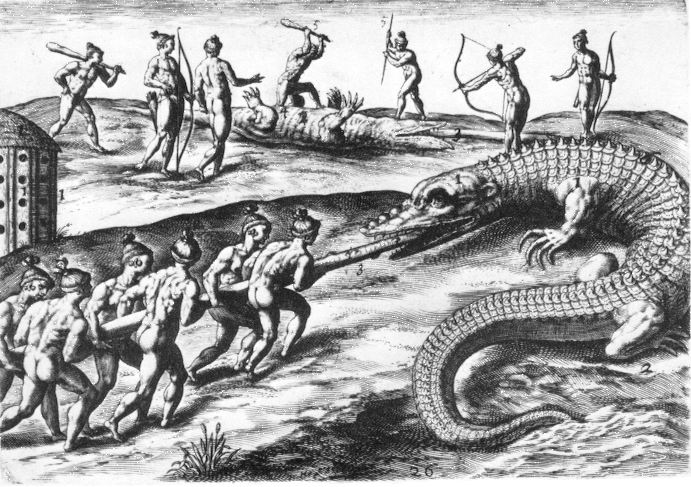
A long time ago I read a news story which reported that a drunk Australian had tried to ride a 5m long crocodile weighing 800kg. He survived, if he was a little chewed. That prompted me to set about searching the internet for pictures to put that croc into context.

And, my... 


Imagine trying to take one of these on with a sword and shield while knee deep in swamp water?

Bring hirelings!

In classic D&D (Mentzer Expert, absolutely my favourite D&D book), a Normal Crocodile is a 2HD creature, averaging at 9HP, doing 1-8 damage per bite. A Large Crocodile, which I guess encompasses the maximum size we find in the real world, is a 6HD creature, averaging at 27HP, doing 2-16 damage per bite. There is also a Giant Crocodile of explicitly prehistoric proportions, but that is beyond what we're talking about here.

A D&D Fighter, remember, will have on average slightly more HP than a monster of equivalent HD to his level - he'll likely have a bonus from Constitution, some kind of minimum HP house rule, or outright fudged dice!

In Magic World (which takes its bestiary from the RuneQuest Monsters book for the third edition of the game, rogue Fatigue Points and all!), the Small Crocodile has 23HP and does 1D10+2D6 damage per bite, while a Large Crocodile has 40HP and does 1D10+5D6 damage per bite.

A Magic World warrior will have perhaps 15HP... full stop.

Big beasts are more frightening in d100 games. But then the play-style in D&D ought be at least a little different from BRP-derived games - certainly where combat is concerned. I was going to write a long post comparing chances to hit, calculating average damage by round, and then I realised that I would end up doing something as boring as the old Monstermark articles in White Dwarf!

So I will short cut all that. I like games in which big beasts are dangerous. But big beasts in D&D *are* dangerous - though I often have to remind myself of the fundamentally abstract nature of D&D combat (and I always need to hold in check my desire for realism and granularity in D&D combat) which means that comparisons with blow-by-blow systems are not always straightforward. But for all the Crockywoks in your game, FANTASY gaming needs DRAGONS. While we shouldn't forget the terrors of 'ordinary' animals (though in a world created, deliberately, by supernatural beings, even ordinary creatures are the product of a god's violent imagination), let's have some bright, primary-coloured fantasy to mix with our realistic shades of  green and brown.

Friday, 7 February 2014

Wham-bang, thank you Mampang! [part two]


Yo, ho, ho, me trumps!

I've been spending a little too much time playing Assassin's Creed: Black Flag. I could be reading good fiction, or painting miniatures, or... Or anything. But instead I am cruising around the Caribbean trying to collect every last sea shanty and hidden treasure chest.

But back to Mampang for the final session of the Crown of Kings campaign.

The party ended the last session captured by the Mampang Guard and brought to see Captain Cartoum. Their Adventure Ends Here. Or well, it likely ought to have done. But as we broke up the penultimate session I said to the players that they needed to think very hard about how they were going to get out of this very sticky situation. Following the between session conversations on Facebook, I was not optimistic.

BUT, many sessions ago I had allowed Ho Lee to spend Experience Points creating a new Sorcery spell. The AFF2e rulebook explicitly advises against this, but in the context of a one-off 'adventure path' I figured, 'why not?' And so Ho Lee's magical experiments had added COR to the Sorcery spell book, an analogue to GOB and YOB. Where those created GOBLINS and GIANTS from the teeth of those creatures, COR brought forth a MANTICORE. When word had reached the Archmage that Ho Lee had very publicly and effectively demonstrated this novel sorcery, he was interested in seeing the innovating wizard for himself.

And so, despite Mopsy's quite frankly hopeless plan to convince Captain Cartoum that this was all a dreadful misunderstanding - that despite killing quite some number of the Archmage's minions, disguising themselves are guards, and refusing to surrender, they were there to enter the service of Mampang - the party were not summarily executed a mere flight of stairs from their goal. No, like any good villain, the Archmage demanded that they were brought to him, and, in his genre-appropriate arrogance, dismissed the guards.

[This bypassed a number of interesting encounters, but the party were not going to have a chance to see those. It was this, or a game-ending consequence. I am very happy allowing players to run themselves into TPK. And with these players, TPKs and near-TPKs are not uncommon! But then I do not normally run a linear campaign.] 

The party were in the Archmage's library-cum-observatory with just the villain and his manservant, Farren Whyde. The Archmage offered the party the Crown of Kings, if they would tell him the secret of the COR spell. Mopsy was up for taking the crown that floated in the air before them, but saner heads prevailed and the Archmage grew frustrated. With the party hesitating, on edge, ready to attack the Archmage, there was a wet ripping noise behind them. The 'Archmage' cowered behind his desk as the body of Farren Whyde split in two to reveal a NETHERWORLD DEMON.

Boss Fight!

But Boss Fights can be boring. They are not a point in the game - most of the time - where the players are able to make any more significant, interesting choices. At this point, it is No Retreat, No Surrender! D hovered his finger over the Big Red Button - as the Demon began to whittle away the PC's STAMINA reserves the ZED spell was readied. What would it do?* But in the end some rather lucky Critical Hits from Cramer and Mopsy snicker-snacked off a couple of points of the Demon's SKILL, and the foul thing fell under the swords of the Heroes of Analand.

In the gamebook, the players could either summon the Samaritans of Schinn (the 'good birdmen', which the party bypassed - to be fair finding the good birdmen rather than the bad birdmen is a 'left or right' decision), or resurrect Farren Whyde and have him summon the birdmen. Anything else necessitates the player fights his way through the now alert Mampang Guard - an impossible task. Not wanting this adventure to play out like the end of Return of the King, I had two options, 1) present the party with wave after wave of Guards, a pointless, hopeless battle that would demand another session of play that would contain no reward and little in the way of meaningful decisions, or have the Samaritans of Schinn show up at the window of the Archmage's Tower. 

Flap, flap. 

"Squawk! Need a lift?" 

Epilogue

Deciding this would be the end of line for these adventurers, I asked each player what they planned their character's long term future to be.

Ho Lee, with the benefit of a few armfuls of the Archmage’s books and paraphernalia, secluded himself in a tower in the wilderness and delved deeply into magical secrets. He was killed many years later by a party of adventurers, who then sold his library in the book markets of Gallantria.  

Cramer, still driven by Slaang, God of Malice, decided that he would seek the leadership of the KLATTAMEN tribe of the Baddu-Bak Plains. By force of violence, Cramer became chief, but his rule was short-lived. Mistaking a hearty respect for violence for a tendency towards cruelty, Cramer abused his subjects, and was lynched after just a few months.

Mopsy, who the spirit of Khare declared to be the new Hidden Lord, was ever the good and noble(?!) knight. Conscious of his duty to his sworn lord, he returned to Analand and persuaded King Arkle to raise an army to allow him to annex Khare. As the pennants of Analand approached the walls of the Cityport of Traps, SULPHUR GHOSTS boiled from the walls, scattering the army. Mopsy was never heard of again, but legend has it that a blind beggar claiming to have once been a famous knight now lives in the slums of Khare. 


*I was set to have the ZED spell transport them to The Pit, where they would continue the battle with the Demon. If they won, I might have been tempted to run an 'Escape the Pit' campaign. If they had lost, well, at least the Demon had been banished.