Showing posts with label DnD. Show all posts

Monday, 10 February 2014

Who Needs a Dragon?

No animal is half so vile as Crockywock the Crocodile...

A long time ago I read a news story which reported that a drunk Australian had tried to ride a 5m long crocodile weighing 800kg. He survived, if he was a little chewed. That prompted me to set about searching the internet for pictures to put that croc into context.

And, my... 


Imagine trying to take one of these on with a sword and shield while knee deep in swamp water?
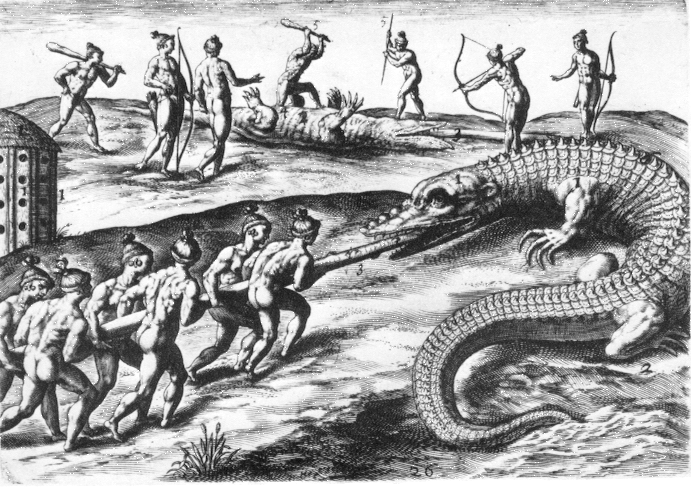
Bring hirelings!

In classic D&D (Mentzer Expert, absolutely my favourite D&D book), a Normal Crocodile is a 2HD creature, averaging at 9HP, doing 1-8 damage per bite. A Large Crocodile, which I guess encompasses the maximum size we find in the real world, is a 6HD creature, averaging at 27HP, doing 2-16 damage per bite. There is also a Giant Crocodile of explicitly prehistoric proportions, but that is beyond what we're talking about here.

A D&D Fighter, remember, will have on average slightly more HP than a monster of equivalent HD to his level - he'll likely have a bonus from Constitution, some kind of minimum HP house rule, or outright fudged dice!

In Magic World (which takes its bestiary from the RuneQuest Monsters book for the third edition of the game, rogue Fatigue Points and all!), the Small Crocodile has 23HP and does 1D10+2D6 damage per bite, while a Large Crocodile has 40HP and does 1D10+5D6 damage per bite.

A Magic World warrior will have perhaps 15HP... full stop.

Big beasts are more frightening in d100 games. But then the play-style in D&D ought be at least a little different from BRP-derived games - certainly where combat is concerned. I was going to write a long post comparing chances to hit, calculating average damage by round, and then I realised that I would end up doing something as boring as the old Monstermark articles in White Dwarf!

So I will short cut all that. I like games in which big beasts are dangerous. But big beasts in D&D *are* dangerous - though I often have to remind myself of the fundamentally abstract nature of D&D combat (and I always need to hold in check my desire for realism and granularity in D&D combat) which means that comparisons with blow-by-blow systems are not always straightforward. But for all the Crockywoks in your game, FANTASY gaming needs DRAGONS. While we shouldn't forget the terrors of 'ordinary' animals (though in a world created, deliberately, by supernatural beings, even ordinary creatures are the product of a god's violent imagination), let's have some bright, primary-coloured fantasy to mix with our realistic shades of  green and brown.

Friday, 6 September 2013

Humanoid Relations


What do Orc bandits do with the loot they take from merchant caravans? What are Goblins planning to buy with the 1-8 silver pieces (of legal tender in human settlements) they carry in their purse. How (and why) do all Elves learn to speak Gnoll and Hobgoblin (without speaking to any Gnolls or Hobgoblins)?

They are the LAW! (Iain McCaig, from City of Thieves)

In my fantasy games I have a habit of introducing a hefty dose of interaction between humans (and demi-humans) and the races of evil humanoids. This might well be the product of a thorough steeping of my youthful imagination in Blacksand, though little things such as the fact that Ogres seem to be a not uncommon feature of human settlements in the Old World of Warhammer Fantasy Roleplay, and that there is an Orcish ghetto in Alfheim in Mystara's Known World has undoubtedly leaked into that stew, too.

So, what is the degree of human, demi-human, and humanoid relations in your games?    

Thursday, 11 July 2013

Ben Elton plays D&D


No really. With Steve Jackson, Ian Livingstone, and... who are the other two guys? I recognise the guy in the white shirt (I think).


Thanks to Gorgonmilk for finding this.

[Update: You can tell I've not done much blogging over the past few months - Orlygg (of Realm of Chaos 80s) posted this video nearly one month ago...]

Thursday, 31 January 2013

The Builders of Byzantia


As we reconvene the gaming group after Christmas, we decided to continue the campaign by having the party return from the mountains empty handed - driven down by bad weather, perhaps. The Beastmasters of Byzantia were disappointed; it is a very competitive calling, with each man judged on the quality and exoticism of his menagerie. But there would be no Hippogriff eggs hatching in their halls this coming spring. Maybe next autumn the party can launch another expedition in search of Hippogriff eggs. The party overwinter in Gateways, brooding on their failure and drinking away the eyes of D'namnas.

The below is what I wrote for the players, presenting some options for adventure.

Your winter passes in a fug of drink and smoke and salted meat. The weather never turns cold enough to freeze the lake, and while the groans of the undead are unnerving, there was, thankfully, no danger of the shambling remnants of the Second Empire of Humanity crossing from the ruins of the Castle of Gaskell the Black to Gateways. Nevertheless, the snow and cold slows life in Gateways down to a crawl... people huddle at home, little news or novelty enter the town. The party enjoys the Festival of Lights during Frostbite, and watch with grim faces as the Baron and the assembled vicars of the churches symbolically bury the world at the end of Earthdeath. They then spend a full week indoors during the storms (and worse) of the Howls of Chaos, when the Intelligences Beyond realise that they have been tricked and the world yet lives.

When the new year begins with the month of Ashunmoon (named after an ancient Alysian shepherd 'saint'), you are keen to leave town. The religious practice Abstention - from anything and everything pleasurable - between the 7th and the 14th, so as to not enrage any malign entities disappointed that the world did not die. There are enough who are devout in town to make this practice all but compulsory.

The first news that comes into Gateways is bad. Goblins, it is reported, have been putting homesteads and farms to the torch. While drinking away the winter, the party made friends with Stephan, a member of a horsetrading clan, he asks that you help his family transport a herd of (very rare) white horses to the Elven market at Rivalyn. Acting as the agent for his brother Pyotr, the head of the clan, he offers 400SP for the party (who have a reasonable reputation now, even if just for the amount of treasure they have squandered) to act as insurance against Goblin horse thieves.

The ruins of Gaskell's Castle are quieter, the [un]dead presumably returning to their restless sleep, but still sits across the water, a black, brooding ruin.

There has been no more news from Abelorn regarding 'the Rahib', but then there has been no more news of anything much. Likewise, there has been nothing new heard of Elwyn, the renegade cleric, though when Abstention is over the Bishop's court is expected to begin it's 'Circle' of the Duchy.

You also hear of agents for the Gnome King of Underhill, who is seeking men and women of repute to protect the the trade caravan containing a winter's worth of industry as it works its way south to Mirror Bay. Mirror Bay is the seat of the Duke and the only 'city' in the Duchy and, therefore, doorway to the rest of the Known World.

The party chose the investigate the ruins of Gaskell's Castle. I decided to place the pyramid of B4 The Lost City in the middle of the ruins of a castle modelled on a Roman fort - the Second Empire of Humanity had a distinctly Roman styling. The style of the pyramid, however, suggests a remnant of an older civilization. I changed much of the details, while keeping the maps and the distribution of encounters (if not the encounters themselves). Major changes had to be made to the different factions in the dungeon; mine are the Builders, the Judges, and the Maidens. The first faction the party met in their delve were the Builder of Byzantia:

The Builders of Byzantia are a human, all-male semi-secret society; almost everyone knows that they exist, but details of their membership, rituals, and purpose are not known with any certainty. Common understanding of the organization runs from the mundane to the fantastical. Many see it as a guild-like network of elite men, some extend this idea and see the Builders as the shadow government of Byzantia, even a cult dedicated to restoring the glories of the First Empire of Humanity[1]. Some will say in public that the Builders are global conspiracy in the service of powerful supernatural patrons. A Demon of Law, they suggest, given the Builders’ emphasis on the virtues of order and planning. There are, though, whispers that the Builders are a hidden cult of Chaos, searching for the secrets of Escherean architecture.

Sample Titles: Grand Planner, Architects, Surveyors, Builders
Alignment: Law
Values: Civilization, Order, Planning, Labour
Patron (publicly, anyway): Saints Constant and Stankov – the founder of Byzantia and a (mythic?) heroic builder. They represent the duality of human achievement and the taming of the world.
Symbol: A pyramid, over which rests a hinged ruler. At the middle of the pyramid is an eye.


The Builders encountered in the ruins of the Castle of Gaskell the Black wear heavy leather aprons marked with the symbol of the Builders. They carry a variety of tools and measuring equipment, and tend to favour warhammers as weapons. Most are NM, others are Level 1 Specialists. Their Leader is Isoclesus, who is a Level 3 Specialist. Classed Builders tend to have skill points in Architecture and Tinkering. Of course, NM Builders will also be proficient in their trade skills (but will be less competent in other aspects of adventuring).

Goal: The Builders in the ruins are looking for technology that pre-dates the Second Empire. So far, they have found a few (inoperable) bits and pieces, and a keen to recover whatever may lie unfound in the depths.

Demeanour: The Builders are friendly towards parties that are friendly towards mostly human (and male) parties, though some heterodox Builders see Dwarfs as admirable fellow men. In general, they see adventurers as the first, crude wave of civilizers; they clear the wilderness of monsters and barbaric humanoids. They are sexists, and disparage the Maidens of Symmetry in vulgar terms. Valuing function over form, they regard the Maidens as the embodiment of their views on women; decorative rather than productive. They fear and despise the Judges, whose adherence to laws as well as Law, and the bloody purges they are wont to engage in, makes them an enemy of progress and human achievement.

Isoclesus is a plump man, generous with his hospitality – such that is possible in ruins. He is fascinated by ants (and other social insects); by their ordered society and prowess as builders. He keeps a glass ant farm in his quarters, and has brought several rare books on entymology with him to the ruins. The distillation of ant scent that keeps the Builders safe from the vicious Black Ants that infest the upper reaches of the ruins is a result of his own research. The Builders ability to move safely among the Black Ants protects them from the other factions.

The party (4 players, 8 PCs of Level 1 and 2) ended the first session deep in the pyramid, having just defeated a handful of Skeletons. That was the only combat encounter in two-plus hours of play, such was the caution of the players, and their intention to find ways down without delay[2]. I also think that they might think that I am a 'dick' DM; at one point I had to say, "If there was writing on the door I would tell you outright, you don't need to keep asking. I'm not going to say, 'Aha, the door said 'trap' and now you're all dead. Ha ha!' Trust me, I will tell you of anything significant unless it is actually hidden." I'll write a play report once they have completed their delve - with a game due tonight (possibly), before I run a different group through  my version of U1 The Sinister Secret of Saltmarsh using DCC RPG tomorrow! And I plan to submit a revised version of an academic paper this week too - busy times!

[1] The First Empire of Humanity fought a war against the Gods and won, driving them into the Heavens. This victory was won at great cost. The war tore through the fabric of reality and allowed the Intelligences Beyond (of Law and Chaos) into the world, and Humanity fell into a long dark age as the other races of mankind came into being.

[2] For all their tactical caution (opening doors, investigating tombs, etc. - to the extent that the lead PC was roped to the rest of the party, to be hauled clear of any pit traps, falling blocks etc. [I'd give a bonus to the appropriate Saving Throw, I guess]), strategically this party can be very reckless, in previous sessions plunging deeper into a dungeon when there are the sounds of angry humanoids behind them (ending in a TPK), and following an evil Mire Sprite (a Mixie) as it beckoned them down a narrow path (which nearly ended in a TPK), for example. So, trying to not be a dick DM, I think I might have to warn them (remind them) that, generally, the deeper you go, the more dangerous things get, and then let the party live or die by their own decisions.

Monday, 28 January 2013

2kCP? It's 1d8SP that's the problem.


I spent a part of Friday[1] converting U1: The Sinister Secret of Saltmarsh[2] for use as an intro game for Dungeon Crawl Classics RPG. I'm still not sure whether I'll invite the players to roll up first level characters, which are pretty powerful compared to classic D&D first levellers, or whether I'll use it as a 'funnel'. A group of townsfolk investigate the haunted house - what could be a better funnel than that? [3] And, never mind the fact that the rest of the U series provides possibilities for future adventure, should the players so choose, U1 itself has the zero-level funnel - The Haunted House - and the first test of the surviving first-level characters - The Sea Ghost.

Converting an [A]D&D adventure to DCC RPG is a piece of cake[4], for the most part. Monsters can be statted up very simply and straightforwardly, and without the 'compulsion' to make every person a properly levelled character so can NPCs, using the examples in the book as a quick rule of thumb. Treasure is not so straightforward. U1, like many AD&D modules, hands out a fair bit of treasure, and more than a few magical items. This runs counter to the intended tone of my game, which,  while it does not adhere entirely to the principles the in DCC RPG that magical items are exceptionally rare and unique and that no-one is lugging tens of thousands of gold coins about the place, does try to keep close to that flavour.

The DCC RPG fanzine Crawl! #2 has a pretty nifty treasure generation system (which pretty much makes magic items an incredibly rare random possibility - but there is nothing to stop you putting one there as a Judge), and Chris Hogan of Vaults of Nagoh has a couple of useful thoughts on treasure [Simplified Corpse Robbing, Corpses as Treasure], and I could always use the random treasure generators from Advanced Fighting Fantasy 2e or WFRP1e (yup, there is one), all of which would provide more appropriate loot than the hundreds upon hundreds of GP on offer in U1. Of course, first I would have to scale back the reward from the Saltmarsh Council - 500GP per person is the sort of money that could hire an army of professional soldiers in AD&D. 

Anyway, I did not mean for the big treasures to be the point of this post, but some of the smallest. So, there's some Goblins, see. And they're each carrying 1-8 SP in their coin purses. If you are going to get flustered by Giant Rats and their 2000CP, you damn well ought be annoyed by this. Why? Because Goblins carrying currency that the PCs can spend raises far more (interesting) questions about the way the game world works than does a pile of treasure in a rats' nest. Does the Goblin economy rely on human currency for exchange? In the default AD&D setting, I'd guess not. Do Goblins regularly trade with human settlements? In the default AD&D setting, I'd guess not. Maybe rarely, when a tribal chieftain carries a strong box full of stolen loot down the crossroads at midnight, to trade with an arms dealer (yes, I know where U are going...). So there is a case for coins in a goblin lair, but 1-8 SP of walking around money...? What are they going to spend it on? Now, despite what is written in U1 (and nearly every other [A]D&D module), in which the Goblin's personal treasure is a handful of coins, perhaps, in fact, they have (silver) jewellery worth 1-8 SP. 

Or, perhaps Goblins do engage in inter-humanoid trade a little more regularly than the default AD&D setting suggests. Perhaps the rules imply a setting that is a bit more Blacksand! than Greyhawk?

They might love their job, but they still want to get paid.

Of course - D&D is a game of abstractions, stupid [5]. Don't break the fun! 

[1] The game didn't happen as everything got delayed and delayed until it was too late to begin, so we played a boardgame instead. Kids, eh? This week though...

[2] Eight pound odd for .pdfs of the complete U series is good value. The scans from dndclassics.com, however, are far from brilliant - nothing like the quality of the free teaser, B1. The whole thing looks shoddy, not least because there are missing characters down the edge of some of the pages. The characters can be easily inferred, but still, it is far short of what I had been expecting.

[3] Well, actually, I'd actually like to see - maybe I'll write - a zero-level funnel in which the players are the mob, pitchforks and all, storming Frankenstein's castle. That's 'Frankensteen', by the way.

[4] Though, we will still have to see how this cake actually tastes.

[5] I'm not saying that it breaks the fun, but if you want the abstractions to make sense - at least relative to each other - then you can do a lot worse than Adventurer, Conqueror, King System (ACKS), which is up there with LotFP as a clean, efficient version of classic D&D.

Monday, 21 January 2013

Predicatability and Meaningful Choice


One of the principles that many people ascribe to Old School play is that player choices (and hence player 'skill') matters. A second principle is that balance - in the 'modern' RPG sense of providing only encounters that are designed to be 'won' by the PCs - is not desirable; in a sandbox game, some things that the PCs will encounter - by design or by chance - will be beyond their abilities. They might have to learn this lesson the hard way, but because the game is a sandbox, not a railroad[*1], the players have plenty of choices of other places to go and things to do.

The retroclones all have standard monster bestiaries and mechanized treasure tables, emulating the original systems. Even if the DM creates his own (variations on these) monsters, the lesson of these catalogues is that players can (and I don't mean by leafing through the monster listing and studying the treasure table) learn what the world created by the GM consists of - what rules it runs by - and therefore gain an ability to judge risk and reward. Sure, Orcs in your game might be called the Quezo'll, and their kings might be able to shoot laser beams from their crowns, but the players have the potential to learn the capabilities of the Quezo'll, get an idea of the size of their raiding parties, the treasure they carry, etc.

This is not about the game itself being predictable - in the sense of beaing boring or repetitive,  but that enough of the world is predictable so that players can make informed, meaningful decisions on the part of their PCs.

Several of the second generation OSR games - Lamentations of the Flame Princess and Dungeon Crawl Classics, for example - suggest that monsters should be unique. There should be nothing so passé as a standard bestiary; monster manuals[*2] reduce monsters down to dangerous animals, and humanoid monsters to evil humans with different coloured skin. I have tremendous sympathy with this point of view, but I worry as to the degree to which an inability to learn about the dangers of the world through actual play inhibits meaningful player choice. Meaningful player choice demands predictability. If the players have no idea what the possible consequences of an action are, what the risks are, or what the rewards might be, then they cannot take a meaningful action. Of course, as these are games of exploration and adventure, many aspects of the world must remain unknown, mysterious, and if magic plays a part, even contradictory. I guess my question is - to what degree is a degree of predictability in 'monsters' required for meaningful player choices in a game that, more often than not, involves fighting (or at least, encountering) monsters?

[1*] I have seen it argued that a sandbox is just a railroad with so many tracks that the players enjoy the illusion of freedom. Well, uh, sort of. For me, the point of a sandbox is not total player freedom, it is meaningful player CHOICE. It is the choices, and the consequences (including PC death and other negative, even catastrophic, consequences) of those choices, that make RPGs a game.

[*2] To be sure, the Ecology of... articles in Dragon, and the tone of the AD&D2e Monstrous Compendia did begin to make even the strangest monsters mundane.

Monday, 14 January 2013

The Five Minute Work Day


There is some complaint that the resource management/attrition aspects of Old School games leads some dungeoneers to game the system by adopting the 'five minute workday'. Basically, once HP are low, magical resources and special abilities have been depleted, and the dangers of the unknown loom ever larger, the adventuring party retreats to a defensible room, barricades themselves inside, and heals, rests, and recuperates. This is the way you would play a C'RPG', so why not an RPG?

Well, there's nothing wrong with that as a tactic. But an RPG is judged/refereed/games mastered by a living, imaginative person, not dead lines of script. And that person is responsible for the behaviour of the rest of the world, including (but not limited to) the monsters of the underworld. There has been endless discussion of the way that intelligent, social monsters can disrupt these kinds of PC tactics. But even the most mindless of monsters can threaten a five minute workday routine; one word, ROMERO!

Since Night of the Living Dead re-animated the zombie as a horror staple, the standard scenario has seen surviving humans adopting the tactics of the 'five minute workday' and coming unstuck. Resources continue to dwindle. The sheer weight of of the undead on the barricades renders the defensible position a deathtrap. The horror, the horror, sends N/PCs insane (even if you don't have a sanity mechanic for PCs, they've brought henchmen and hirelings, no?). 

And even when the five minute workday is so well organised that it prodiuces something akin to the  moment of post-apocalyptic, post-scarcity utopia in Dawn of the Dead, there are always NPC parties interested in the same treasures. Some of those treasures are already in the PCs' possession...

 Murder-hobos ahoy!

Sleep well in the dungeon.

Saturday, 12 January 2013

Experience, Charisma, and Glory


Some regard Charisma as a 'dump stat'. It is a bit difficult to have a 'dump stat' when you are playing 3d6 in order, but you know what I mean; STR 18 gives you a +3 bonus in melee combat, DEX 18 gives you a +3 bonus to AC, CON 18 gives you an extra 3 HP per level. Even modifiers provided by high INT and WIS can provide mechanical in benefits; extra spells, higher chances of knowing a language, bonuses to Saving Throws or adventuring skills, depending on your particular flavour of The Game. But CHA? CHA? CHA 18 should give you a bonus to NPC reaction rolls and an increased maximum number of henchmen. But these are small beer; how many modestly endowed PCs are maxing out on their henchmen allocation? And how many Old School GMs set aside roleplaying to randomly determine NPC reactions? Or remember to?

Now me, well, I am comfortable enough with a Fellowship test, or the like, as in WFRP, to use some kind of CHA test to determine the success of a PC's attempt to inveigle their way into the Black Brotherhood, or persuade the Archgourmand of the Ogres that adventurers are poor, stringy, gristly meat. But even in those cases, it is the actions of the players, not the dice rolled for their PCs, that carry the most weight in determining the success or failure of their actions. The +3 to hit provided by STR 18 counts whether or not the player of the PC can actually lift a sword; the player simply says, 'I hit with my axe' and the GM says 'roll'. The effect of the +3 to NPC reaction rolls provided by CHA 18 is dependent on the ability of the players to put words in their PC's mouth.

Cha-, Cha-, Charisma eighteen, Russia's greatest love machine

Regardless, CHA can be made mechanically meaningful in an Old School game by making it every adventurer's Prime Requisite. And then some. A +1 bonus (CHA 13-15) = 10% extra XP, a +2 bonus (CHA 16-17) = 20% extra XP, and, naturally enough, a +3 bonus (CHA 18) = 30% extra XP. That is a lot of extra XP, but then someone with CHA 18 is a person that is more likely than most to turn the bare facts of their deeds into legend.

But then, for me, XP are not literally a measure of 'experience' - after all, what do PCs get XP for? Finding treasure, mostly. Sometimes killing stuff. And, if you are that way inclined, completing quest-like objectives. And accumulating this XP does what? Makes PCs better at fighting, others better at magic, and some better at sneaking about. The same experiences improve characters in different ways. Why? Because D&D is not a BRP game. D&D is a more abstract (and less 'realistic'). In my games, XP (and Levels) are measures of a PCs fame, glory, and legendary status - I've argued before, D&D [only?] makes sense when adventurers are 'rock stars' - though this 'legendary status' is only in part a social construction (boosted by carousing and conspicuous consumption too; you can buy 'charisma'), but is built into the physics of the game universe itself.

The idea of using the CHA modifier* to boost XP rewards comes from a number of sources: Mongoose RuneQuest II uses CHA to determine the number of improvement rolls that a PC gains per session/adventure, on the [dubious] basis that charisma helps PCs find tutors/training partners better than gold, or intelligence. Pendragon has a Glory statistic that is a combination of a Player Knight's repute and something more 'real'. Old School games have, since they were New School, awarded XP for carousing and the like (Chris Kutalik, of Hill Cantons, not only does this but increases PC Charisma scores as they level, looking at the relationship between CHA and level from the other end of the telescope [take one // take two // Hill Cantons Compendium]). But the tipping point came when I was reading some Pelinore stuff, and came across the Free/wo/men NPC class. "The level of a Freeman or Freewoman is not determined by experience points but by a combination of their wealth, age and influence". At first I though that NPC classes such as this are a great way of avoiding the situation in which every NPC of interest has an adventuring class and a few levels, or else is a fragile 0 level non-entity. But then I thought that the idea of levels relating to 'wealth, age and influence' might help us to think about what XP and levels are meant to/ought to represent. 

*I am all about the modifiers these days. I'd rather have a PC roll 1d6/2d6/xdy (whatever) and add their modifier to beat a target number, than roll 1d20/3d6/xd6 (whatever) to roll under the relevant statistic. Using d6 rolls to resolve adventuring tasks obviously owes a lot to the streamlined D&D rules found in Lamentations of the Flame Princess. 2d6, though, gives a probability curve, and Stars Without Number (via Traveller) provides an example of how to use this in an Old School context. Dyson Logos has a nifty conversion of B/X Thief skills to d6 and 2d6.  

Thursday, 20 December 2012

On Ability Scores (2)


More stuff that everyone and their dog has written about before:

In the last post I said that most NPCs in D&D should not have ability scores. By this, I don't mean that we shouldn't bother writing them down, I mean that they should not have them at all. Ability scores in D&D are not the same as characteristics in RuneQuest (RQ). In RQ, every living thing is statted out just like a PC because in RQ characteristics are a measure of something ‘real’. A Dragon’s STR can be compared directly to that of a PC. In D&D monsters do not have ability scores. If a monster needs only a bare stat line, so does an NPC, though they might have rich, complex histories and personalities.

In most versions of D&D, education does not raise INT, weight training does not raise STR, an improved diet does not raise CON. One of the weaknesses of thinking about D&D ability scores as a measure of something ‘real’ in the game world is that if, for example, we rationalising low CON as being the result of a PC’s obesity, a PCs CON score should be pretty mutable, changing with diet and exercise. If we treat D&D ability scores as representations of a Platonic ideal of the PC, the CON score will remain the same for the entire life of the PC. We might change the PC’s ability score modifiers though...

Wednesday, 19 December 2012

On Abillity Scores (1)


On the forums at Dragonsfoot I argued that a D&D character with an ability score of 3 was simply at the low end of ‘normal’. The corollary of this is that scores of 18 do not represent superhuman capabilities. Others took a much more stretched view of the 3d6 ability score curve, arguing, for example, that INT 3 represented an intellectual disability and INT 18 genius.

Scores of 3 and 18 turn up on 1 in every 216 rolls of 3d6. If everyone rolls 3d6 in order, that’s at least one genius in every village (and one villager that is superhumanly wise, superhumanly dextrous, etc.). So INT 18 is not the equivalent to Einstein, but to the guy with the [capacity to get a] first class degree in Physics.

But perhaps everyone in the village is not rolling 3d6 in order, and so 18s are not as common as 1 in 216 in the general population. In fact, I agree. We roll 3d6 to determine the ability scores of adventurers. In fact, I do not think most NPCs in D&D [should] have ability scores. If 3d6 is the way that we generate the ability scores of adventurers, an ability score of 3 is the ability score of a viable adventurer. An adventurer with a negative modifier when resolving actions related to that ability, but an adventurer all the same. But whatever a score of 3 represents, it does not represent a disability – ability score generation is not a roll on a critical hit chart; not even Warhammer Fantasy Roleplay is that cruel and grim.     

Tuesday, 11 December 2012

Who Rolls The Dice?


There have been a few posts about the place recently [here are two: Tenkar's Tavern and Raven Crowking's Nest] that have discussed dice rolling and the temptation to 'fudge'. 

Tenkar writes: "By fudging the rolls, you are moving from RPG to Storytelling. [...] That to me is the issue - are you playing a game or a looking for a storytelling experience?" And I pretty much agree with this. As a GM, I have less fun - in retrospect at least - when I have succumbed to the temptation to fudge the dice and ensure that a particular outcome was arrived at. Even if the players do not know it, I have diminished the 'game' when I 'fudge'. 

To help me resist the temptation to 'fudge', like many I roll my GM dice in the open. Where possible, I tell the players what I am rolling for and what the different results will mean - so long as to do so would not reveal a 'secret'. But lately, I've been thinking of surrendering the dice. No, I'm not taking up a diceless system. But when a player can be given the full details of the roll without revealing any secrets, why not let the players do all the rolling? Let the players roll the dice for the monsters that are attacking their PCs, for instance. 

There are still a few people with a sense of humour in the Imperium

Why? On the most basic level, because people like rolling dice. More, it will defeat much of the remaining temptation to 'fudge'. And last, and most, it will diminish any sense that the GM-player relationship is adversarial - that I, as the GM, am rolling against them. My dice are rolled to administer the world. The players' hands and dice are responsible for adjudicating the outcomes of [almost] all the risks facing their characters.

Well, we will see next time we play. 

Tuesday, 20 November 2012

Hippogriff Mountain


To bring us up to date with the current campaign (following from clearing Kalten's Keep and the Exploration of the Mire Wood [One, Two]); The party rested for a few weeks, and considered their options. What was going on in Gateways?

+ Elwyn the Renegade Cleric is still somewhere in the foothills of the mountains west of Gateways. 

+ The Elf who was smoking away his sorrows in the Island of Lost Dreams is dead, and so, therefore, are any leads. Who knows what the Rahib has managed to do in the intervening weeks down in Arbelorn? Consolidate his power, probably…

+ The ruins of the castle on the lake are groaning again. Literally. The castle was once home to Gaskell the Black, ‘King’ of the Mountains. Gaskell was one of the last open worshippers of Um’hurabbu, the Angel of Law that was the power behind the Second Empire of Humanity. The mass executions Gaskell performed centuries ago have left a stain of damnation on the island, and the dead regularly wander the ruins. Periodically the ruler of Gateways, currently a nephew of the Duke, Sir Marcius, hires adventurers to put a stop the infernal – literally – racket. There’s a 1000SP reward for any party who can ‘silence those who have forgotten that they are dead’.

+ There is a murderer on the loose in Gateways. In the past week, a whore and a known pickpocket have both been found gutted, their eyes poked out. The local sage, who might just be a bearded drunk with an authoritive line in story telling, sees the hallmarks of the Chaotic Entity Vis’aya, the Dissolver of Boundaries, in these murders.

+ The Beastmasters of Byzantia have sent an agent to Gateways, looking to buy Hippogriff eggs, or even better, a Hippogriff fledgling. They are willing to pay 1000SP per egg, or 3000SP for a fledgling. There are rumours of Hippogriffs nests high in the mountains that lie west and north of Gateways.

What do you want Hippogriff eggs for? Ah. Aieee!

After some debate, the party decided to have a chat with the Beastmaster, to learn a little bit more about Hippogriff, their habits and habitat, and their mission. With 1000SP on the table, they took up the offer, and equipped themselves with mules, ladders, rope, tents, torches, spears, a wardog etc. (they had read the Old School Primer by Matthew Finch in the meantime), as well as a couple of hirelings. I had rolled up a hexmap of the mountains using the system in Advanced Fighting Fantasy 2e (the wilderness is a dungeon), and the tables from Basic/Expert D&D and Labyrinth Lord. Some interesting encounters, and with the difficulty of travelling in mountains, the party were in for quite a few days in the hostile wild.

Near where the Foamfall River tumbles out of the mountains there is a small village. Once, it was a boom town, back when the mine was being worked. Now, most buildings stand empty, with a few families of goatherds that eke a living from the hard lands, and a transient population of prospectors hoping to strike it rich, long after most had given up hope. A pretty unlovely place, but they did have a fine line in goat sausages. Tully, the hermaphrodite Halfling, bought a string.

The party discovered that there were, indeed, Hippogriff in the mountains. The goatherds lost goats to these flying predators with frightening regularity. The villagers also believed that there was a Griffon in the mountain, a massive beast worshipped as a god by the primitive mountain people. This was something to avoid.

The party headed into the mountains, taking the route up to the Shrine of Saint Bvarn, rather than skirt the mountains to investigate routes into the mountains around the abandoned mineworkings. The Shrine of Saint Bvarn is a 20 foot face of bearded man carved into a cliff face. Inside the open mouth were barrels of grain and a few other supplies. At the back of the ‘mouth’ there was a closed wooden door. Which the party declined to open.

With no obvious path, the party stuck close to the cliff face, camping in the open. Heading higher into the mountains, they ran out of cliff face to follow. The party decided to head towards the Foamflow, the best part of a day’s travel north. As they came into a narrow valley, the party spotted a group of seven fur clad humans. Or were they humanoids? And were spotted in turn. The party was cautious, and the CAVEMEN yelled out a warning (or was it a greeting? or a threat?) before moving surefootedly over the broken rocky ground and out of sight. 

The party reached the Foamfall, which here in the mountains was a fast flowing river in a deep, sharp sided gully. The party followed the river upstream, until they came to a small building. The party investigated cautiously, and found that the building was roofless and abandoned. A short distance away from the building was an iron gate set across a tunnel that headed down, under the Foamflow.

The party split. One group, led by Tully, readied the building to be used as a camp that evening, while the more martial members of the party headed underground. The iron gate opened to a staircase, at the bottom of which was a dull orange glow. In a passageway deep underground the party found five figures sat in a circle on the floor, their hands stretched out towards a ring with a glowing orange gem. The figures, three large, two small, didn’t respond to the party’s calls. Chip used his spear to send the ring a few yards down the tunnel. The desiccated ZOMBIES groaned; some turned to desperately follow the ring, the others attacked, but the party made short work of these slow, brittle monsters. With the Zombies reduced to dust, Chip took the ring. The gem a pulsating, glowing orange, he ignored the warnings of his comrades and put the ring on. A sense of warmth coursed pleasantly through his body.

Declining to investigate the tunnels under the Foamflow any deeper, the party returned to the surface and enjoyed a Halfling cooked meal. The party surmised that the building was a shelter for goatherds and other mountain travellers, but with it in such a poor state of repair, a family had sought shelter from the elements underground. How long they had been down there before they had died, and how long they had been undead, it was impossible to say. As was the relationship between the glowing orange ring and their undeath...  

Friday, 9 November 2012

Jenny Greenteeth and the Mire Woods: Part 2


After several weeks of game time rest, the adventure in the Mire Woods continued:

The Party (this time consisting of Chip, Dale, Petra, Myna (an Elf, played by A), and Tully (a hermaphrodite Halfling, played by C), with BRAN, a porter, and GILGRIM, a man-at-arms) returned to the Mire Woods to investigate the temple. They found the cottage of JENNY THE HAG, who confounded the Party with her invisibility. She eventually bargained with the Party, once she was satisfied that a bunch of armed men and women were not there to rob that. She exchanged a Potion of Invisibility for some tobacco and the promise of something interesting, magical, or arcane from the Mixie’s temple.

Travelling up the Vein, the Party killed a GIANT CRAB and a MIXIE, before avoiding a nest of STIRGES and more GIANT LEECHES as they surveyed the area around the temple. They found that the ‘throne’ moved to reveal a trap door, and explored the underground complex. Quickly locating the likely location of the Mixies (a warm door with a sweet smell), the Party decided to explore before confronting the Mixies. They found a sacrificial altar guarded by short SKELETONS with the top of their skull removed and silver coins in their eye sockets. They found a statue of a beautiful woman with the top of her head missing and something in the ‘bowl’. The party did not look inside. They found a circular room with a spiral mosaic on the floor. At the centre was a bed, with a plaque that read; “rest ye here and be reborn”. Underneath the bed was a trapdoor and mechanism of some kind, which they declined to investigate further. They found a terrifying nightmare frieze depicting a journey to Hell, which could incapacitate the weak-minded. With time, real and in-game (the party wanted to be out of the Mire Woods before nightfall), they charged into the room that they suspected to be the lair of the Mixies - and they were right. The Mixies were cut down in short order, managing only to Charm Bran and leave Petra with a broken arm (8 weeks out).

The party recovered a great haul worth about 4000SP. In the hands of the statue of D’NAMNAS (depicted as a pissing, rearing black horse, with human hands and spider-eyes made of jewels) they found 10 Gold Crowns from the Second Empire of Humanity. They left one in the Demon’s hands, and gave the other 9 to Jenny the Hag, who claimed to be able to feel the weight of evil. She rewarded them with another Potion of Invisibility.


Other Goings On in Gateways:

The Bishop's agents are still looking for adventurers to investigate the renegade Cleric Elywn.

Several parties went through the trap door in Kalten's Keep. None returned, until last week, when Jorkal climbed out of a secret passage in the woods, laden with treasure. None of his party survived - he described a warren of crypts filled with undead, and a secret ossuary filled with laughing skulls. Jorkal has been drinking and whoring away his treasure; he was a taciturn humourless man before striking rich, but since his return, laden with silver and gold, he has been a changed man.

The Elf in the Isle of Lost Dreams (a black lotus den) eventually wasted away. The Party saw his body being loaded in a coffin and surrounded by ice - the madam of the 'Isle' sold his possessions, and then sold his body to agents of RANGA MARR, a wizard and anatomist in Mirror Bay. Apparently, he is experimenting with reproducing Elven 'infravision' - the ability to see in the infrared spectrum.

An old sage heard the Party’s stories of the Mixies and launched into an exposition on D'namnas, a Chaotic demon associated with dreams and nightmares. The spider eyed, human handed horse is one of his forms. Mixies, he claimed, were once Elves, but sometime during the Second Empire of Humanity they became degenerate through their worship of Chaos. He has read, he said, that they reproduce through the nightmares of their victims.

A Green Dragon flew over the town. Some of the guards in the High Tower were foolish enough to loose arrows at it - annoyed, it wheeled in the sky and exhaled a cloud of noxious green gas, before swooping over a nearby farm, plucking several cows from the ground. It disappeared, heading towards the highland east of Kalten's Copse. When help reached the High Tower, they found the bodies of the guards, skin blistered and burned and their tongues swollen in their heads.

Wednesday, 17 October 2012

Adventurer, Crippled, Killed


This morning I bought the .pdf of Adventurer, Conqueror, King System. Mainly because I was interested in the fantasy economics that are designed to fit the assumptions of D&D (I've sent the players in our game to their post on 'The Demographics of Heroism') rather than model historical economics. But, on opening the 'book', one of the first things that I went to was the awesome, single page, Mortal Wounds table, right at the back. Oh, am I going to love inflicting everything from, 'Ghostly visions of lost companions flicker before your eyes as you awaken', to,'Your lips and tongue are severed or mangled (cannot speak, cast spells or use magic items involving speech, -4 to reaction rolls)' on the PCs in our game. It is a good middle ground between single table simplicity and the pages and pages of tables and detail in WFRP1e (with the Character Pack, at least) and Rolemaster.

The thing to remember with Death and Dismemberment tables and the like is that they actually make D&D less deadly - 0HP does not equal insta-death - but they make death much more colourful AND they explain why there might be people with permanent injuries in a world that would otherwise works on the principle of, 'he's fine, he's fine, he's fine, he's DEAD'.

At the moment, I'm only envisaging using ACKS for the economics, some of the ideas about ritual magic, and the mortal wounds table. I prefer LotFP for the core adventuring mechanics and simple, well defined classes. But you never know... it is another D&D-alike to add to my original books (AD&D1e/2e, BECMI/RC), my retro-clones (Labyrinth Lord being my go-to clone) and my simulacra (Crypts and Things, LotFP, and now ACKS). That's a lot of D&D, and lots of things to pick and choose from in there.  

And if we're speaking of copper coins, I really do like the ACKS Treasure Generator.

Saturday, 13 October 2012

On the Great Copper Coin Debate of 2012


So some GIANT RATS have 2,000 copper pieces, do they?


Well, so what? D&D is a GAME of ABSTRACTIONS. HP, AC, Characteristics, Saving Throws, Levels...

Do you want more detail? If it is the round numbers that bother you, make something up or use the random number generators that came in that red box you bought thirty years ago. If it is that there is a pile of coins in the lair of Giant Rats that bother you, remember that 2,000CP is 20GP* worth of treasure that weighs 2,000cns / 200lbs (at AD&D convention of 10 coins to 1lb) / 40lbs (at AD&D2e convention of 50 coins to 1lb). In other words, a big, bulky treasure that isn't worth very much. A nice piece of furniture, perhaps.

I play treasure all three ways - "here's a pile of 2,000CP" / here's a pile of 1,876 Emirati Coppers / "as you catch your breath [after fighting the Giant Rats], you notice that the sideboard on the far wall would complement the furniture of your dining room."

D&D is a game in which advancement is driven by loot. Even if Giant Rats having piles of coins (or any treasure) wouldn't make sense in the real world (if there were such things as Giant Rats), it MUST make sense in a D&D game world. Okay, maybe Giant Rats could be Treasure Type: NIL, but the principle that monsters (might) have treasure, and that this treasure is relatively easily convertible to GP/XP, is an essential part of D&D. 

*Correction - In AD&D it is worth all of 10GP.

Thursday, 11 October 2012

Carousing & Companionship


Carousing is a feature of many Old School games. Some give out xp for carousing, and for some, excessive, extravagant, public spending is the old way to turn 1gp into 1xp. I like these ideas, especially as I’m of the mind that one of the best ways to understand ‘the adventurer’ is to think of them as ‘rock stars’. A world in which professional adventurers are a relatively common sight, in which the successful ones end up rich beyond anyone’s wildest dreams, many die young, and those that live long enough end up as establishment figures with large, country estates… yes, that’s a rock star/D&D adventurer.

With this is mind, levels are understood as more than increases in skill, but broader abstractions that also include increases in fame/notoriety. This idea is already built into the classic games by the fact that higher level characters automatically attract followers, can build strongholds, etc. It’s not just the fact that a character is a good swordsman that allows him to attract a body of loyal, armed men at name level. It is that everyone in the Duchy knows that the character is the best sword in the Duchy.

So far, all I’ve done to mechanise this is to give xp bonuses for high Charisma, and for successful boasting. Extravagant spending might warrant an xp bonus, too… but it’ll have to be on something truly useless, with bonuses for inventiveness. I am thinking of codifying it – probably pinching wholesale from Chris Kutulik’s Hill Cantons Compendium – but for the moment we will play loose with these ideas.

However, extravagant spending on ladies (and men) of the night, or on less mercenary seduction, is not just a means to bolster the ‘rock star’ image of the adventurer. In Mikedemia Press' City Book (which I  really like, so I ought to write about it sometime - and it appears that it is still available here), an optional rule suggests that adventurers are so filled with lust (well, it doesn't exactly say that) if they do not find companionship they risk wasting away entirely.

I think 'Cities' is great - I have the version (loosely) for RQ3, but it's packed full of tables usable for any game.

“Characters must have companionship at least once every five weeks, or see their abilities to concentrate, study, and cast magic steadily deteriorate. Relevant characteristics and skills might drop by a few percentiles or a point or a level a week until companionship is obtained.”

Adventurers as Russel Brand? Hopefully not – Errol Flynn, perhaps!

Saturday, 6 October 2012

Jenny Greenteeth and the Mire Woods: Part 1


Over Thursday and Friday night (which spanned three weeks of game time) the party explored the Mire Woods in search of Georghe Tincu, the son of a wealthy ice merchant. The boy had lived large parts of his life on the river, travelling on his father’s boats, and it was assumed that he had disappeared while exploring the river. Raglan Tincu has hired several parties of adventurers to scour the countryside.

One particularly lurid theory is Jenny Greenteeth, the monster of the Mire Woods, has taken the boy. The problem was that the locals couldn’t agree on just what Jenny Greenteeth was. A water serpent with a woman’s head, a beautiful but evil maiden covered in river weeds, a child-eating old crone…?

The (shorthanded) party, consisting of D’s Fighters Chip and Dale (!) and A’s Magic User Kitty, accompanied by Nalag, a Goblin porter, and Hengist, a Human man-at-arms (thanks to Meatshields!) followed a stagnant, slow moving stream known locally as the Vein into the Mire Woods. The Mire Woods are a thick tangle of trees, roots, and undergrowth, and so moving along the river avoided the risk of getting lost and moving exceptionally slowly, both of which would equal an increased possibility of a frightening night in wild and weird part of the world.

I'd love to see one of these well funded Kickstarter and Indiegogo OSR campaigns commission some work from Ian Miller... 

The party picked up the trail of someone with boy sized feet on the muddy bank, passed the opportunity to investigate the body of an adult, and were ambushed by a GIANT LEECH. A ‘small’ Giant Leech, which killed Nalag, reducing the already scrawny Goblin to a bag of a bones. So much for that ‘encumbrance sink’.

The party were less keen on travelling on the muddy bank of the Vein after that, slipping knee deep into the brown water with a regularity that was a little more sinister now that they had encountered one of the inhabitants hidden below. Not far up the stream, the woods thinned on both banks. A path on the right bank led away into the forest, illuminated by globes of light ‘hanging’ in the trees. On the left bank a path that might be little more than an animal trail led away from the river. The party were uneasy at the idea of walking down a path lit by balls of light, and so headed along the trail.

There they found Georghe’s exhausted, wounded older brother Vitali. Desperate to be a hero, he had set off at dawn in secret, but had run into a flock of ‘vampire birds’ (STIRGES). The party tended to the sobbing and desperately weak Vitali, rested, ate and watered, and decided to return the boy to the edge of the woods, where their boatman waited.

The party decided to venture back into the Mire Woods, keen to find Georghe. They enjoyed an unfathomable standoff with a wild Elf, mohawked and inscrutable, bow at the ready. He recommended that the party relax in among the flowers, before he disappeared into the woods. The party came across a marble birdbath, dedicated to Victoria Kalten (‘may this bring you their relief that she never found’), but decided not to disturb the crystal clear water in the basin.

Then, coming across a rise, they found a clearing carpeted with poppies. As they crossed the clearing, heading back towards the vein, A asked if Kitty noticed anything unusual about the flowers. Kitty bent down, heard a crunch underfoot, and noticed that under the flowers the clearing was covered in brittle fragments of bone. The party began to run… and kicked up the pollen as they did so. Chip (or was it Dale?) failed his Save vs Poison, as did Hengist the man-at-arms. Chip was overcome with the urge to simply lie down and watch the clouds. Chip wrestled Dale free of the clearing (or was it the other way around?), and as they passed the edge of the clearing the magical effect of the pollen changed dramatically, with the flowers disappearing and the murder hidden by the flowers visible in all its gore.

Nobody fancied going back in to save Hengist – he was just a meatshield, after all – so the last the party saw of him he was lying down, drinking from his wineskin, with various bits and bobs of the party’s equipment on his back. Including Dale’s (or was it Chip’s – seriously D, two characters with one class, one background, one personality, and not quite two names makes it hard to keep track) long bow. Make the hirelings carry the oversized equipment, sure…

Breath caught, and nerves calmed, the party found themselves back on the banks of the Vein. A brook of clear water joined the stream on the far bank. The party caught the briefest glimpse of a pair of beautiful, naked, green-skinned three foot tall women frolicking in the stream. They turned, smiled, and beckoned the party to follow them up the stream. A clear trap, but if the party wanted to get the boy back…

The party followed the green-skinned temptresses, who flitted in and out of their vision, up the stream, until they reached a large, shallow, roughly circular pond of still, clear water, sitting in a bowl of mud walls. At the centre of the pond was small ‘temple’, open on all sides with simple white columns holding up a roof, not much more than seven foot tall. At the centre of the temple was a ‘throne’, upon which sat Georghe, an expression of dreamy content on his face. Eight MIXIES – a particularly evil form of Nixie dedicated to D’namnas, a Chaotic entity associated with the disorder of dreams and nightmares – surrounded the boy. One stroked his hair.

A Fighter, played by D, fired his heavy crossbow, impaling one of the Mixies. The Mixies transformed into something vile; the lower parts of their faces extending into a leech-like ring of teeth and bony spikes protruding from their wrists. Ululating, they summoned two (small) GIANT CRABS from their lair in the mud walls of the bowl. Chip and Dale cut down the Mixies in pretty short order. However, Kitty, seeing a Mixie move to attach her leech-like mouth to Georghe’s neck, charged. The Mixie speared her through the eyes – while Kitty was only reduced to 0HP, A rolled a 1 on the Death and Dismemberment table. With the Giant Crabs closing, Chip and Dale decided to retreat, and splashed down the Vein as the day ended and the Mire Wood filled with shadows.

They didn’t tell Raglan Tincu, or anyone but the absent members of their party, that they had seen Georghe, or about the ’temple’ deep in the Mire Woods. Tincu rewarded Chip and Dale for returning Vitali. For some reason, as they rested, waited for the other party members to recuperate, and drank in the taverns of Gateways, Chip and Dale span a story that Hengist and Kitty had run off and abandoned the party. Whether this lie will have any repercussions remains to be seen.

Two weeks later (the following night), Chip and Dale returned to the Mire Woods with a few more swords…

Thursday, 4 October 2012

Kalten's Keep and Jenny Greenteeth


After the TPK in the Caves of Mykonos, and a time playing other games over the summer (including playing Tower of the Stargazer, which I hope to write about later, with a different group of players) we re-booted the D&Dish campaign with a pretty simple, straightforward adventure. Kalten fitzKalten, a fat, rich young man who claims to be the heir to the seemingly extinct Kalten family, hired the party to clear the old Kalten Keep of its occupiers. Kalten's Keep is Castle Caldwell, from B9, with a few of the rooms moved around and a rationale given for the range of occupiers; the band of GOBLINS had been running the place as a 'hotel' for travellers who have some reason to stay off the roads and away from towns such as Gateways. Gateways is 'my' Threshold - I've enjoyed offering the players the chance to send their characters shopping in Gateways.  The party of eight PCs (two per player - intended to mitigate against the chances of a TPK driven solely by a couple of poor rolls and to allow the players at least the hope of levelling - a key part of the D&D experience. Plus, have you seen how many PCs are expected by older modules?) took two sessions to clear the Keep. We don't play that long; the time between getting the kids in bed and tiredness overwhelming us isn't that long.

The first session, they took rooms in the 'hotel'; their Goblin hosts unsuccessfully trying to confiscate the party's weapons. After being shown to their rooms - which contained debris that once was a bed, at most, they began to investigate the Keep. Sensibly - and surprisingly, this was the same group of players who managed to get surrounded by Goblins for their last TPK - they didn't launch into any combat. The BANDITS told them to get lost, in less polite terms. The KOBOLDS yipped and yapped at them. Calisteri the CLERIC, dedicated to the Screaming Saint (a cult dedicated to the intolerance of all other Men-Kinds - she could only stomach staying in such a contaminated place as just to south of the Keep there was a centuries' old shrine to Humanity Undivided), invited the all Human party to take devotional prayers with her. Of course, sooner or later the party were going to run into their hosts, and, given that some of the PCs could barely walk they were carrying so many weapons, this was bound to lead to tension, and sure enough it boiled over into conflict. The party quickly cut down the GOBLINS, split, as they were, into two groups of four. Hearing (and in some cases seeing) this carnage, the rest of the intelligent inhabitants of the Keep barricaded their doors and made plans to leave - their accomodation had been invaded by a gang of murder-hobos!

All except Calisteri, who offered to help heal their wounds, as they were clearly here to do Holy work. As it was, the bandits, the Kobolds, and the MERCHANTS, all got out of the Keep with their treasure. The animals that infested the Keep, including STIRGES, FIRE BEETLES, a GIANT SHREW, a SPITTING COBRA, and WOLVES took a bit more effort to deal with. The party rested (in the rooms that had been occupied by the merchants, which contained beds!) lugged their first haul of coins back to Gateways, leaving it guarded by Juan, the Cleric, who had been blinded - which was not as unsafe as it sounds. He had a loaded crossbow - there's no class-based weapon restrictions (so far) in this game) and the party were stopping at the Headman's Axe, a particularly secure inn, the landlord of which is Goryn, an OGRE (humanoids are not exactly accepted in My-stara, but attitudes are a little more varied than simply, 'exterminate the brutes') who was the state executioner for the previous Duke. Buying a mule, in the (sadly misplaced) expectation of more treasure than they could carry, the party returned to the Keep and engaged in a battle with the Fire Beetles, in which (I hope) they learned the value of a good Armour Class. Most of their opponents had been AC7 (13 in the ascending system that I favour). The chitinous exoskeletons of the beetles, however, gave them AC2 (18), and as the battle dragged one, 3 PCs fell. Using Chris Kutulik's Death and Dismemberment table, with a -1 modifier for each HP below 0, we saw a broken leg, two fingers ripped off, and a very nasty facial/head wound. All that for 30xp. These injuries will need up to twelve weeks of recuperation, so we'll be seeing a couple of new characters join the campaign in the meantime. 

So, back to Threshold, er... Gateways, for the party. The game this Tuesday (which might well have involved beginning to play a modified version of Rahasia - the party found an Elf babbling away about 'the Rahib' in the Isle of Lost Dreams, a Black Lotus den) was cancelled as most of the players couldn't make it (except my wife, who struggles to pull out of a game played at our dining table). One could, and he asked if we could play a mini-adventure, and, despite my misgivings about the dynamics of just two players (and a DM), I rolled up a short one-session adventure; a merchant's boy has gone missing while fishing just downriver from Gateways. The locals seem to think that he has been taken by Jenny Greenteeth... 

I like to offer my players more options than, 'here is the adventure', but at short notice, what else can you do? Here is my prep:

Oh, to be able to map like Nicholson...
 
Only, that last player (excepting my wife) then cancelled, so we'll be playing tonight. Do not enlarge the photo, Dave, you cheat! The rest is in my head. Not many locations, but as I said, we aren't able to play for all that long these days. I think that is why I'm keen to build resource management - a key part of D&D - into the space around the adventures, by making sure that healing takes time, living costs are deducted, spell research takes time and money, etc. Of course, there's nothing wrong with running multi-session adventures, in which managing resources during an adventure figures more heavily, but absent players can quickly choke the momentum from a campaign when everyone is waiting to pick up from where the party left off last time. With injuries like the ones suffered exploring Kalten's Keep, whether we like it or not we'll end up with a broad 'cast list', presenting the option of running parallel adventures with a different set of characters.

Monday, 1 October 2012

Nothing New Under the Sun


In our games of D&D (or whatever it is) I had been using the long trusted method of dealing with natural 20s and 1s in combat; double damage and a 'fumble' respectively. Of course, under this system a high-level fighter has exactly the same chance of scoring a critical hit as an clumsy child, and they both stand the same chance of dropping their swords. And it is more than a bit implausible to have even high-level fighters dropping their swords once every twenty combat rounds. In the past, we've played combats with these kinds of fumbles and have had swords flying all over the shop, bowstrings snapping like elastic bands, and sling stones scattering all over the slippery dungeon floors. Funny, for sure.

So for fumbles, we've just adopted the rule of two - a natural 1 leads leaves the unlucky dungeon delver with one round -2 across the board penalty, to hit rolls, armour class, saving throws, and anything else that might pop up. So everyone over stretches themselves once every twenty combat rounds, but the more able characters are more able to cope with the effects.

As for critical hits, I've seen houserules that try to emulate the RuneQuest critical system, where higher skill=a broader window of scoring a critical on the attack roll. Most of these involve rolls a certain number over the target number being a critical success, i.e. the lower the THAC0, the better the chance of striking a critical. Those systems look too fiddly for D&D. So I took my guide from WFRP1e, which allows the d6 damage dice to 'explode', so long as a second roll against Weapon Skill is made, and decided that a natural 20 would prompt a second attack roll. In other words, a natural 20 might cause 'double damage', but only if the attacker is skilled enough to 'hit' again. Another natural 20 results in another attack roll, and so on. But the chances of a series of natural 20s are microscopically small. Sure, you might kill a dragon in one blow, but only once every century or so... 

And then I sat down yesterday with my Rules Cyclopedia, my AD&D1e PHB and DMG, and my AD&D2e PHB and DMG, all to try to work out what I'd make my D&D players pay as upkeep costs. I didn't want them scrabbling for coppers in vein of our WFRP1e games - this was meant to be D&D(ish), after all - but I didn't want the game to completely ignore these things. My AD&D2e DMG is a much travelled book - it was posted the Dominican Republic to me for my birthday in the early 1990s, came back across the Atlantic to sunny Scotland, and since then has followed me around the UK - so it is no surprise that several pages are loose. One of these loose pages described the optional critical hit systems. And one of these systems was the system described above.

Who'da thunk it?

Nothing original.    

Nothing to see here. Just the story of a gamer finding that everything he thought of had been first invented over twenty years ago. It is funny feeling like one of the designers of D&D Next, eh?

p.s. Tenkar's thoughts on Attacking the Darkness certainly bear thinking about as an alternative fumble system, mind. They seem original, but who knows what rules are hidden in my gaming cupboards?

Friday, 28 September 2012

Playing it Wrong


At the moment, we’re playing Lamentations of the Flame Princess (LotFP). And we’re doing it wrong. Wrong, wrong, wrong. Why? Because we’re using the core mechanics of LotFP and playing classic D&D with it. That isn’t what James Raggi wanted, is it? But it is a compliment.

The core mechanics of LotFP are D&D made elegant. I love them. The combat rules (this is the game that converted me to ascending AC), the streamlining of weapon options, the d6 adventuring rules, the rules for spell research and the creation of magic items… and the Specialist! A classic D&D Thief that doesn’t suck! LotFP is the version of classic D&D that I want to play. But I want to play classic D&D with it. I want the tone of the Mentzer Basic/Expert sets mixed with some Brit-fantasy to darken the mood. But it’s laughable thinking that a dash of Titan, a pinch of Lone Wolf, and a sprinkling of Warhammer will ‘darken’ a game when LotFP provides the possibility of mis-casting a Summon spell and have a party compelled to genitally mutilate each other? Actually, the mis-casts of the Summon spell are BRILLIANT. But they’re not part of the game that I’m after at the moment.

I’ve got my Rules Cyclopedia on my table as we speak, and my BECM (never did get I) books sit in a box alongside my collection of Gazetteers, modules, and assorted classic D&D accessories. But RC/BECM (or Labyrinth Lord, which I use as a proxy to avoid having tea poured all over my precious, precious RC) it isn’t exactly the game I want to play either. It lacks the elegance of Raggi’s system, and it’s power scaling is all wrong. 36 levels?! Back when I began playing D&D I had the Basic and the Expert set, and that was the system. 

So my house rules try to use LotFP to play D&D. All classes increase in attack bonus (though much, much more slowly than the Fighter. Not every monster is a unique Cthulloid entity; we’ve got Kobolds and Goblins, Trolls and Treants. The spells are mix of LotFP (Raggi’s interpretations of the classic spells are often extremely well done) and classic D&D (well, actually, for ease of reference at the table, I’m relying on Labyrinth Lord quite a bit). And I’m using D&D Treasure Tables – a mechanised Experience Point system that runs on loot demands a mechanised loot allocation system. In other words, I’m doing Raggi a terrible insult, stripping away the deliberate and consistent tonal qualities of LotFP to leave myself with the skeleton of the rules.

I'm worried about tea? It looks like they'll fall apart of their own accord soon enough...

The thing is, I appreciate the tone that Raggi strove for when writing Lamentations of the Flame Princess. It’s something that I’d be happy playing as a player. Strangely, it’s a game that I'd probably be happier playing that running. But right now, we’re dungeon delving and monster bashing. And, when you end the first adventure with a character blinded by a SPITTING COBRA, and three characters (a serious head wound, two fingers severed, and a broken leg)  needing lengthy spells of recuperation thanks to some FIRE BEETLES (oh, and Chris Kutalik’s Death and Dismemberment table), you know that you’re not playing too light and breezy a game.     

Oh, and of course, the Rules and Magic books for LotFP are available free. They're art free, but if want some cutting edge art criticism, try HERE. God knows what I'll do with my FOUR Rules and Magic hardcovers when they arrive (thanks to the Indiegogo campaign), but I'm looking forward to the Ken Hite adventure. And Kelvin's.