Wednesday, 28 August 2013

The Quest's The Thing


And the thing is...

Well, the other week we wrapped up the Shamutanti Hills portion of the Crown of Kings campaign. The PCs path to Khare takes them through the village of Torrepani, home of a tribe of miserable SVINN. These ugly half-orcs recently visited by BANDITS (the very same group that the PCs had recently crushed - literally, given that Ho Lee had summoned a GIANT using the YOB spell), who had (out of sheer badness?) kidnapped the daughter of the village chief and dropped her into the Sacrifice Pit to be eaten by a monster.

In order to rationalise the actions of the BANDITS I decided that the monster was widely held to be (semi-)divine, and that the BANDITS, led by FLANKER - who I decided was in the pay of the ARCHMAGE OF MAMPANG - were just the kind of men likely to offer a sacrifice to a dark god before taking on a KNIGHT, a SORCERER,  and some other guy (I don't think it does to be too famous and recognisable as a THIEF). Of course, that the usual offerings to the dark god might be made by the SVINN is something that the PCs never thought to investigate.

The PCs passed the hut of the witch GHAZA MOON, and accepted her offer of tea (hurrah! For once, PCs a game that I am running have decided against antagonising magic user of unknown powers). I decided that she had an interest in the well being of the SVINN - not necessarily out of any goodness, mind you - and would provide the PCs with some background as to the troubles of Torrepani. As the GM, I was keen for the PCs to take on the monster, as victory would see the village shaman restore their missing SKILL points, depleted after FLANKER and the BANDITS had rolled a succession of critical hits. And that even I am thinking about playing a hand in husbanding the resources of the PCs in order that they jump the hurdles placed in front of them exposes the problems of 'The Quest' model...

So the PCs descended into the Sacrifice Pit, and with a reminder of the riddle they had been told just a couple of days ago - but weeks ago in real time - they finally worked out not to traipse down trap-ridden passages. Once that was settled, this was essentially a Skyrim dungeon - one twisty passageway that leads the PCs to the 'boss fight', picking up the missing SVINN girl on the way. And having the passageway behind them collapse, eliminating almost all choice on the part of the PCs. Quests, eh?


And the boss? A MANTICORE; the body of a lion, the tail of a scorpion, the wings of a eagle, and the face of a sad old man. The last bit makes this monster really quite nightmarish in my imagination. But the fight was over in short order - Ho Lee had summoned a couple of GOBLINS, which allowed the party to overwhelmingly outnumber the MANTICORE. Mopsy the Knight hid behind his shield and Cramer used his athleticism to dodge the swipes of the monster's great paws (both fighting Defensively, adding +2 to their Attack Strength in exchange for causing no damage - before this fight I talked the players through the way in which combat options and situational modifiers work with regard to chances of success, concerned that SKILL 12, three attacks and poison tail would be a PC killer if the players weren't aware of the ways in which their choices might play out mechanically). With the two 'fighty' PCs drawing the beast's attacks, Ho Lee and his GOBLINS attacked from the flanks. And when the MANTICORE rolled double one in the first round, the fight was all but over. I rolled that the monster lost its attacks for two rounds, and I ruled that the MANTICORE had got its paws tangled in the piles of bones that had accumulated it its lair. In the end a summoned GOBLIN finished it off, vanishing with a squeak and a flash of magic and the monsters collapsed on top of it.

I confess, I didn't give the MANTICORE much of a chance. I had it attack the two 'fighters' who met it head on (and then dodged and hid), rather than deal with the daggers slashing away at its sides. I also forgot to apply an Armour Roll on the first catastrophic round, sapping its STAMINA points away at a quicker pace - though its defeat was inevitable (and if the PCs did win it didn't matter how badly they were damaged). Outnumbering really matters in AFF2e - the next time the PCs encounter a lone monster, I'll rule that it only begins being outnumbered when it is facing more attackers than it has attacks.

So the village of Torrepani put out their bunting to welcome back the chief's daughter, and the PCs. In the celebration, the PCs were rewarded with restorative magic, a small bag of gold, and a few portions of Provisions, ready to set off for Khare when we next play.

And now, some half-formed thoughts about 'quests'.  I'm not talking about 'quests' or missions that take place in a sandbox setting, in which the obstacles to PC success can be firmly fixed as existing 'in the world', and PCs choosing to attempt the quest can also choose to abandon their attempt (perhaps returning to it when new information, power, or inspiration reaches them), suffer the consequences of failure, and pursue other player defined PC goals.  In such a game I would think little about allowing clues be left unfound or having a monster outmatch the PCs - though I'd hope that I'd offer the players enough information regarding the riskiness of their choices - as the game would continue regardless. But, if the game is in itself a more or less linear quest (if 'campaign' is defined as a Adventure Path rather than as a series of adventures involving the same PCs in the same setting, linked though player choice rather than GM determined plot) largely consisting of an unavoidable series of encounters, then the game demands that all encounters must not only be 'winnable', but also very difficult to 'lose'. Failure ends the game. If there are vital clues to find, they must be designed to be found by all but the poorest PCs, if there is a necessary macguffin, it must be practically handed to the PCs, and if a MANTICORE must be fought, then the MANTICORE must be reliably defeatable by the PCs as they exist when the encounter occurs. Because they don't find the clues, if the macguffin doesn't end up in their possession, if the monster (or any other obstacle) standing directing in their path outmatches them, and if retreat and goal realignment are not possible or make no sense, then the PCs face game ending defeat. Designed defeat.

In a gamebook, you roll up a new hero and begin again. Or cheat. In a sandbox, the PCs will meet failure by making new choices that address the consequences of their actions in the game world perhaps they flee to the hills to form a guerrilla band as the ARCHMAGE starts a continent spanning war.  While I might well try to 'open' up the later chapters, short of turning the game into a implicit sandbox, it will remain a quest in which failure to leap the unavoidable hurdles will end the game. 

Neverthless, we're having fun with the Crown of Kings campaign, and we have the delights of Khare, the chaotic strangeness of the Baklands, and the classic Fighting Fantasy location: the wizard's citadel. And I am looking forward to exploring the strangeness. 

Monday, 26 August 2013

Oldhammerers, I send my apologies


Due to a number of different, perfectly boring reasons, I will be unable to make this weekend's Oldhammer Day. I'm sure it will be a great day.

I guess I'll just have to resolve to finally paint up my Dwarf Regiments of Renown as compensatory Olhammering.

Apologies.

Thursday, 1 August 2013

Dungeoneering in Yorkshire


Brief holiday over. I didn't finish the Gouged Eye, but I did make some headway, and later models are looking much nicer than the first sample linesman. I introduced a cousin to Bloodbowl, but otherwise gaming was limited to a few drunk games of Articulate, Ingenious, and Jackass. Fun, mind.

We did go on two days out, though, that will probably have an effect on the dungeoneering that our group undertakes in the future. The first was a trip with the girls to Forbidden Corner, self-styled 'strangest place on the world'. If you have kids, and live in the north of England, I really recommend a trip to Middenheim - sorry, Middenham - but make sure that you book, as while it seemed largely undiscovered a few years ago when I first went, it is now very popular, and visitors are limited so as to not spoil the atmosphere. If you don't have kids, borrow some and take them.

The place is a fantastic (emphasis on that word, in at least two meanings) folly, with a maze, various odd statues and hidden gardens, a haunted crypt (which is new) and 'riddle' poems dotted everywhere. At the far end of the Corner (you enter through a massive, burping mouth) is a 'castle'. After climbing up onto the battlements, you descend, climbing down narrow staircases, into a 'dungeon', complete with occult rooms and a kingdom of rats. Frightening enough for little kids to get a real kick out of it, and weird enough to inspire fantasy gaming.

The second day out was to Caphouse Colliery, the National Coal Mining Museum for England. Amazingly, the underground tours are free (and so I chucked a fair bit of money in the collection box), with ex-miners taking you for a tour designed to show you conditions in English mines from the early 1800s to, well, the end of the underground coal mining in England. I wonder if there will be museums dedicated to recreating the workplaces we've lost over the past few years... Curiously, there were more than a few ex-miners on the tour as visitors (including men who had worked at the same pit as my uncle, grandfather, etc.). Not sure I'd go on a tour of any of the offices that I had worked in, but then I doubt the tour guide would be as engaging, or the subject matter as engaging as 'dangerous industry deep underground'.

And that is what will bleed back into my gaming. Movement rates in D&D? Ludicrously slow you say? Perhaps, once you move the adventure outside a dungeon, but underground, in narrow, low ceilinged tunnels, with uneven, slippery floors, in TOTAL darkness, where the earth or the air itself might kill you just as surely as the GOBLINS? No, that is slow, difficult, and dangerous going. A little sample of being deep underground will add colour (mostly black) to my imagination of the underworld - even if I'm not skilled enough to evoke that in play! 

So, it's not about going all Dungeoneers Survival Guide, overdosing on injections of realism into our games, but finding the right combination of the fantastic and the realistic. 

Sunday, 21 July 2013

Blood Bowl Holiday Project


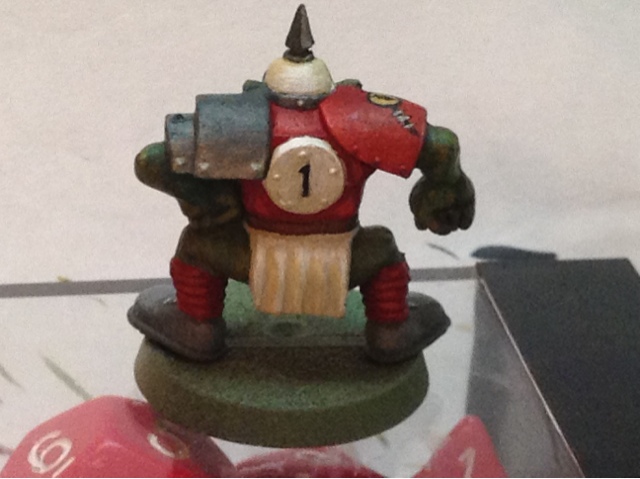
A modest holiday - just over a week at my parents - gives me the best opportunity of the year to do some sustained painting. Baby sitting, innit. So my project is to paint up at least one Blood Bowl team. I thought  would start with the plastics that came in the 3rd edition box, and opted to begin with the Orcs. Deciding that I'd use classic Blood Bowl colour schemes (which in my mind has morphed into a much longer term project of painting up all the classic Blood Bowl teams!) and it was a coin toss between the Orcland Raiders and the Gouged Eye. The Gouged Eye won, so here we go...


Step one, undercoat in green...


Base coats and few skin highlighting...


Not bad for a test model. Hopefully I will speed up as I paint up his teammates. I was quite pleased with the 'gouged eye' symbol and the half-arsed non-metallic metal on his helmet and shoulder pad.

And now for some sad news: there are very few Blood Bowl miniatures left on the Games Workshop website. To be reborn in Finecast? I dunno - but there are other manufacturers, and there is always eBay.

Saturday, 20 July 2013

The Great Shamutanti Swindle


So, Crown of Kings – Graham Bottley’s adaptation of Steve Jackson’s Sorcery! gamebooks to Advanced Fighting Fantasy 2e – got on the table a couple of evenings this week. Come Tuesday afternoon, while I was prepping for what I had expected to be a WFRP2e game, I found that I would have an extra player. For a number of reasons I decided that we’d keep the WFRP2e game on hold, but rather than switch to a boardgame I decided that we should still play an RPG, but at short notice I would need to run something that I have an intuitive feel for. Advanced Fighting Fantasy fitted the bill, and as I have trekked across the Shamutanti Hills more than a few times a lone hero (most recently by playing Inkle’s nifty iOs app) I have a good feeling for the setting.


I printed out the pregenerated characters from the Arion site, the reference sheets, and the John Blanche map of Kakhabad, and with just the barest of prep time we were ready to run. ‘A’ chose the ‘Rogue’ (Cramer), ‘C’ the ‘Knight’ (Mopsy - ?!), and ‘D’ the ‘Sorcerer’ (Ho Lee). Over about four hours on Tuesday and Thursday night the party made it as far as just beyond Birritani and a desperate fight with FLANKER THE ASSASSIN and his BANDITS. The fight might well have been straightforward, even though the party was slightly outnumbered, but, thanks to AFF2e’s rules on Critical Hits (double 6s) and Fumbles (double 1s), it ended up with Mopsy and Cramer losing their swords, having to fight on with daggers (and therefore losing 2 points of their Swords Special Skill) AND being wounded by Critical Hits which cost them a point of their SKILL proper. And as anyone who has played a Fighting Fantasy gamebook will know, a few points difference in SKILL and a fight can be very one sided. 

Luckily Ho Lee had a couple of teeth that he had pulled from a gigantic skull, as so was able to cast the YOB spell and summon a HILL GIANT into the action, who made mincemeat – well, pate, actually – out of the BANDITS.

The players enjoyed the fast paced play, and the fact that – as I pointed out in my rant about the Pathetic Aesthetic – Fighting Fantasy characters (whether in AFF2e or in the books) are extremely competent characters*. I hadn’t appreciated just how effective the Critical Hit and Fumble system is as introducing a real element of risk into fights. I was actually worried that the fact that a GOBLIN is as likely to cause a Critical Hit as a master swordsman – and that they would both Fumble as often – would be a problem. But not so. The PCs most often had/have the edge in SKILL (+Special Skill), which makes them highly likely to win most fights. But the fact that a PC is always at risk of an opponent rolling a double six and knocking a point off his or her SKILL score, or rolling snake-eyes themselves, means that the PCs cannot just wade in carelessly – that needless fight against a GOBLIN, even though it was won, the result never In much doubt, might have consequences that last longer than a rest to eat Provisions. Snowballing consequences that, when the PCs do meet monsters or NPCs of roughly equal competency, might be their undoing.

Also, I do not know how many times players in my games will randomly attack powerful wizards. In Tower of the Stargazer, it led to a TPK. In Crown of Kings, Mopsy decided that he’d had enough of Vancass’ riddles and tried to cut him down. A lost SKILL point later and the party had no choice but to marching into the Troll Woods to continue on the road to Khare.

The players appeared to enjoy the strange, fantastical style of encounters typical of Fighting Fantasy. There was some complaint that it was ‘like a dungeon’, and that there wasn’t much ‘story’, but given that the players can’t hold the names of the three villages they had passed through in their heads, or have the wit to write them down (a memory lapse that left Vancass hopping from foot to foot, singing ‘wrong, wrong, wrong!’, prompting Mopsy’s unchivalrous attack), I’m not sure what they would do if we were playing, say, Call of Cthulhu… 

However, I DO feel that the Shamutanti Hills could have been turned into something more sandboxy – it would be more to my taste to have had advice in the book of how to handle ‘off path’ travel that didn’t amount to ‘frustrate the players until they follow the path’, but this is at least in part a legacy of the source material, gamebooks – and an injection of a sense of the connections between the villages/encounters. To be fair, I could have done more of this – with more prep time, of course – and I DID create more opportunities for the PCs to gather information that would allow them to make (somewhat/imperfectly) informed decisions on the path (literally) to take. The adventure could also do with some kind of ‘ticking clock’; unlike in the gamebook, in which YOU can only move forward, there is nothing to prevent PCs retracing their steps and taking the path not (yet) taken. And there is nothing wrong with thorough exploration, but when the Crown of Kings is winging its way to Mampang, there ought be reminders of the urgency of the quest In this adaptation, as in the gamebook, time is linked to encounters – the villages populated by stunted hill people are often a day’s travel apart (which is not too unreasonable), but the presumption written into the adventure is that the PCs have not dallied, retraced their steps, or otherwise upset the schedule. Again, this is nothing that a GM could not add in, with a little thought.

But I’ll moan about anything! I have enjoyed running Crown of Kings so far, and the players have enjoyed playing in the Shamutanti Hills. Fast paced and flavoursome, I’d sum up so far. So, where’s the swindle? Well, pretty much everyone in the Shamutanti Hills is charging obscene amounts of money to stay in their mud hut, to eat Hillfox stew, or to drink some rough local ale. It is like some tourist trap, with the naïve, rich visitors paying many times the price the locals pay. Hell, the PCs even encounter a bona fide tourist attraction, the Crystal Waterfall, and even that costs 3GP a dip (though the price does come with a complimentary towel!). The PCs (the players?) got so annoyed with the grasping locals I am surprised that we didn’t see them engage in some terrible act of murderous infamy that would echo across Analand. Still, there is time… 

*I must, say, I thought I was making it clear that the Pathetic Aesthetic is not (necessarily) about playing incompetent characters, by using an example in which even the lowest rolled character, SKILL 7, is still more able than most of the monsters of Titan. The Pathetic Aesthetic is about the presence of catastrophic risk in which (by the nature of ‘trad’ RPG gameplay, in which player choice is about what their PC does, not what happens to their PC) negative outcomes might well not be meaningful (say, by being a plot-related sacrifice, or tragic), but meaningless (pathetic). Of course, the negative outcomes don’t have to be meaningless, they are, after all, the outcome of player choice vis-à-vis risk. But as with ‘story’, this is something that emerges (or should emerge) after play. A PC ‘hero’ dying in a pointless fight with KOBOLDS at the beginning of a quest to return the Key of the Hellgate can be meaningful after the fact – the bards would sing (if any are left after the shapeless horrors of the Inferno have spilled forth) of the hubris of the hero who thought himself invulnerable. But it would not be anyone’s idea of a ‘character arc’ (or what have you) when the group sits down to play module PA1 Quest to the Gates of Doom!

Thursday, 11 July 2013

Ben Elton plays D&D


No really. With Steve Jackson, Ian Livingstone, and... who are the other two guys? I recognise the guy in the white shirt (I think).


Thanks to Gorgonmilk for finding this.

[Update: You can tell I've not done much blogging over the past few months - Orlygg (of Realm of Chaos 80s) posted this video nearly one month ago...]

Wednesday, 3 July 2013

One Player Roleplaying


I've known for some time that some of the original D&D games involved single player sessions (as well as sessions involving a larger number of players than contemporary RPGs cater for). Typically, though, these involved higher level characters, who had outgrown the 'party model' of adventuring. Wayne Rossi has recently written about this model for high level play in a post called Party versus Retinue. However, sometimes - like when your gaming group involves people trying to finish PhDs, start second(!) PhDs, pursue anti-folk music stardom, or just people trying to manage the mundane demands of adult life - you have one player and would like to not only run a one-shot, but run a (parallel) single player campaign. In my case, with my wife. Aside from starting at a high level (which is perfectly possible), what other options are there? What games/settings are better suited for running a single-player campaign?

This book is on my office shelf. Didn't give me much advice on running single player RPG campaigns...

Old School D&D seems a bad fit. At lower levels it is dependent on the party dynamic, in which each character fills a particular niche, a combination of which are required for successful dungeoneering. The single player would either have to play a number of PCs, or there would need to be a retinue of levelled DMPCs accompanying the PC, neither seem particularly satisfying. Of course, D&D doesn't need to be about dungeoneering, or a version of wilderness exploration that replicates many of the dynamics of the dungeon. It doesn't have to involve adventures built on the model of published modules, featuring multiple PCs. That said, there was the HHQ (Head to Head Quest - a title I don't like as it sounds too adversarial) series of Fighter's/Wizard's/etc. Challenge modules, but these look to be more a model for a single player 'fill-in' adventure than a model for an ongoing campaign. You could take a leaf from the advice in some of AD&D2e's Complete [X's] Handbooks, which contained advice on running campaigns without the traditional spread of party roles (transforming an 'all Fighter' campaign into a 'only one Fighter' campaign shouldn't be too hard). Or, also from the 2e era, the historical reference books contain plenty of advice for running games that do not feature dungeons or dragons. But if that is the sort of thing that you are going to use D&D for, aren't there better systems for that kind of play? 

Specifically those systems with a weaker degree of 'niche protection'. A skill-based system? King Arthur Pendragon obviously springs to mind. Everyone is a knight. A discussion about player character roles in KAP would run something like this; What's your characters' role? He's a knight. And yours? My character is  a knight. And you? Also a knight. More, the source material involves knights spending years questing alone (often, seemingly, without their knightly retinue!). I know that David Larkins has been running the Great Pendragon Campaign with his wife as the only player, but while I pluck the GPC off my shelf every once in a while I find the whole thing just so... intimidating. Call of Cthulhu also features plenty of solo 'adventurers' in its source material - but they don't tend to last long enough to get a 'campaign' going, and without 'party backup' even a brief spell of insanity - a likely outcome for a PC in CoC - might be an adventure/campaign ender. Which fits with the source material, but I'm not into RPGs as fiction emulators (why would I be, I've got fiction for that), but as games. There is always the option of the retinue - an primary investigator and his or her NPC companions/employees. Or contacts - not all of an investigator's 'resources' need be mobile, the action doesn't take place in a dungeon so having expertise distributed about the city (or other setting) is no handicap, and prevents the PC being accompanied everywhere by a largely silent, mostly invisible, and almost will-less party of NPC niche-fillers. But, for proper solo player fun, Unbound Publishing has produced a very nice looking collection of adventures for single investigators. And it is FREE - Monophobia: A Fear of Solitude. 

Single player science fiction gaming tends to face the problem of spaceship crews, in which it is assumed that the 'party' will be a captain and his or her senior officers. But crews can be so large that they are a collection of unnamed, undefined NPCs, so what is the problem if there a few named and defined NPCs under the command of Captain James PC Kirk? In fact, in situations in which command and decision making is so heavily invested in one character, and thus, possibly, in one player, might not space-faring sci-fi be the ideal setting for single player roleplay gaming? On my shelves I have Stars Without Number (which has the 'niche protection' problem of all OSR games), Mongoose Traveller (which has starting characters begin play a bit less than Captain Kirk), and Rogue Trader (in which one player - the Rogue Trader - is essentially Captain Kirk with skullz! all over his or her uniform, in command of a gothic cathedral of a spaceship exploring the stars beyond the Imperium).

But what about something more like 'traditional' fantasy? A skill-based game with less emphasis on combat seems the best fit. A d100 system (OpenQuest, Magic World, RuneQuest) has obvious attractions, particularly those that have systems to create characters with a bit more experience. With more organic character improvement, they provide scope for a solo player to explore the world according to their interests, and be shaped (mechanically) by those experiences. While my tastes, 'crunch' wise, typically tend towards running simpler systems - OpenQuest over RuneQuest, for example - with just a single player / single PC (perhaps with hirelings/henchmen/sidekick) the crunch factor weighs less heavily, and with fewer characters in play I'd be happy (even welcome the chance) to play with slightly more complex mechanics. An opportunity to put the Combat Manoeuvres of Mongoose RQII (or their evolution in RuneQuest 6, if the book ever finds its way into the hands of a UK distributor) into action, without keeping track of a handful of PCs controlled by players struggling with the rules?  

But my eyes keep falling on my big, fat Warhammer Fantasy Roleplay (1e/2e) books. The career system is the signature feature of WFRP, but in my experience it isn't fully exploited in multiple player campaigns. If a PC really is going to become a Mercenary Captain, he or she needs to go out and do that, not investigate the Purple Hand. If they are going to become an Assassin, they need to set themselves up as Murder, Inc. If they want to be a Demogogue, they need to get rabble rousing. And so on... In a multiple player game, these things are either handled 'offstage' (an informal 'Winter Phase'), which reduces the career system to 'levelling up', or the players need to bring the advancement priorities of their PCs into alignment. A single player campaign, on the other hand, allows movement though the career system to be much more organic, a feature of the play itself, as the PC explores the Old World.

All this said, Solo Heroes from Sine Nomine Press - who never seem to put out a bad book - is not only free, but boasts of being a hack to Old School D&D (specifically, Labyrinth Lord) to enable single player gaming. I'll have to put it through its paces at some point, but at a glance the hack fundamentally shifts the balance of risk in D&D, and for this outing I want the game to (mechanically, at least) run the same whether I have one player or five, to allow the integration of extra players without calling for a 'reality shift'.

Anyway... what system would you use? What would you want to use? What experiences of running single player RPGs do you have?

[edited a little, as it read as if 'you' would want to play a single player campaign with my wife!]