Showing posts with label Fighting Fantasy. Show all posts

Wednesday, 3 July 2019

Fighting Fighting Fest 3


Unfortunately I can't go - I'll be at the Wales v Ireland Rugby World Cup warm up match in Cardiff that weekend. I'll not be playing, though I am Welsh qualified, having played for a club in Cardiff for a few years, so I best take my boots.

YOU should go to Fighting Fantasy Fest, though.

Tuesday, 11 June 2019

AFF: I've got (Special) Skills...

...they're multiplying!

So sang the famous Ogre minstrel, Jhon Revolta.

Luckily, in AFF2e there isn't quite the proliferation of Skills that can be found in some games (I'm looking at you, iterations of BRP). Plus, having Hero competency based off a generic SKILL score rather than finely sliced into different skill ratings means that a PC doesn't end up being extremely able in one area while incapable in another closely related area (though I am of the opinion that when this does happen it is as much a problem of the players (including the GM) as it is the system).

Nevertheless, in the AFF2e core rulebook there are a whole bunch of Special Skills, grouped into Combat, Movement, Stealth, Knowledge, and Magical. It is here, with the Skill groupings, that I sometimes start thinking of AFF as a kind of 'Junior RuneQuest' (there's also some bits of Titan that suggest a RuneQuest influence). These grouping have no effect on the game, but can help players when choosing to allocate Special Skill points, organise Special Skills on the character sheet, and might point the way to simplified or player-defined Special Skill categories.

More Skills are added in the expansion books Blacksand!, the Hero's Companion, The Titan Herbal, etc. There is no reason why a player could not discard this list and simply assign points to 'areas of expertise' (in negotiation with the GM to make sure nothing too broad or narrow is selected) or even to 'sources of power' - want to have a PC that can accomplish things through their 'Love', their 'Curiosity', or their 'Beauty'? Well, why not make it as Special Skill and bring it into the 2d6 resolution mechanism - AFF2e is a pretty loose game, with resolution mechanics that are pretty 'abstract', so why not? If this doesn't sit right, these things could always be added as custom Talents (see next post).

Special Skills are rated between 1 and 6, with the rulebook saying that "A special skill of 1 point indicates someone who has had basic training, 2 points indicates fully trained, 3 points can be considered an expert, and 4 or more a master" (AFF2e p 25). This sits uneasily with the standard task resolution mechanism which is to roll under SKILL + Special Skill (or roll + SKILL + Special Skill if using the alternative 'roll under'. As such, I have thought carefully about the ways to understand SKILL and Special Skill in AFF2e. I'll not rewrite those arguments here, but will point you to the appropriate blog posts:

Skill Rolls in AFF2e (November 2014)

HWWJD: More on AFF2e Skill Tests (November 2014)

AFF2e: The Virtues of Asymmetry (June 2015)

AFF2e House Rule: Capped 'effective' SKILL (August 2014)   

These posts preempt much of what I have to say with regard to the 'Game Rules' chapter of the rulebook, in terms of simplifying (and, in a some senses, expanding) on how to handle Skill rolls in AFF2e.

Next up: Talents.

Thursday, 23 May 2019

AFF: Your Adventure Starts Here (Part One)

I picked up the Advanced Fighting Fantasy (AFF) 2e rulebook with a view to, as promised, write a 'review'. I could write a chapter by chapter description of the content, but that wouldn't be all that much help. And I realised that it is actually quite difficult it is to write a 'review' of a book with which you are intimately familiar, as surprise and novelty that highlights in your mind the distinctive features of the book have long faded. 


So let's start at the beginning. 'Fighting Fantasy' is the name of a series of gamebooks. You know this. But keep it in mind when thinking about the mechanics of Advanced Fighting Fantasy 2e. A Fighting Fantasy gamebook character sheet looks like this:

  
Just a handful of characteristics, SKILL, STAMINA, and LUCK, a space to write down your characters' equipment, their gold, and their Provisions. And that's enough for perfectly usable 'lite' multiplayer game, especially back in 1984 when 'Fighting Fantasy: the Introductory Role-playing Game' was released. As the gamesbooks had introduced a generation (in the UK and beyond) to fantasy gaming, chances were that anyone up for playing Fighting Fantasy as a tabletop RPG was already familiar with the rules and jargon. 


Advanced Fighting Fantasy adds to character complexity. Obviously. When I'm flipping through a rulebook in my friendly neighbourhood hobby shop one of the first things I do is find the example character sheet. I'm of the opinion that character sheets are a good proxy for complexity/crunch, especially the degree of complexity that is 'player facing'. I tend to play with players who don't have a background in RPGs, so this matters to me.


Let's begin this series proper - a review of everything AFF2e - with a discussion of character creation. What makes an Advanced Fighting Fantasy character? 12 pages; character creation takes up 12 pages of the AFF2e core rulebook. Character creation in AFF2e is a process of design, not random generation[1]. There is an alternative method offered in Chapter 11 - Optional Rules that involves rolling and allocating dice to generate the basic stat-line and the number of Special Skill points available. Given the granularity of each step up in SKILL (or SKILL+Special Skill) I would hesitate to recommend this optional rule.

Starting characters (Heroes in AFF lingo) have a SKILL of between 4 and 7, STAMINA between 8 and 16, LUCK between 8 and 11, and MAGIC between 0 and 7. What do each of these mean? Well, putting it in terms familiar to players of the original fantasy RPG, STAMINA are equivalent to Hit Points, LUCK is something like a (finite) Saving Throw resource, and SKILL and MAGIC are... 

...well, it is best to think of these two characteristics as fulfilling the same role as the concept of 'Level'. Especially SKILL. A Hero with SKILL 7 is just much better at everything than a Hero with SKILL 4 - on an unmodified test the former succeeds 60% of the time and the latter just 20%. This applies to almost everything risky that the Hero might do. This strikes some people as being quite odd, even as their Level 7 Wizard has more Hit Points, a greater chance to hit, and far better saving throws that the professional soldiers they might hire as retainers. SKILL is a game abstraction, a measure of overall adventuring competence, and in my opinion AFF2e works better when you 'lean into' this idea.

MAGIC can be understood as something skin to 'casting level', acting as a measure of a Hero's competence and, depending on the type of magic, determining the size of the Hero's reservoir of magical power in the form of Magic Points (MP). It can also be used in place of SKILL when the test is of a Hero's knowledge (p55). If, as a Director (the AFF term for GM) you have players with Heroes with MAGIC higher than SKILL, it is worth thinking very liberally about this, and expanding this to any tasks for which knowledge, intelligence, insight etc. play a role that is as, or more, significant than physical attributes.    

Abstraction. Abstraction. Abstraction. Have I said it enough? MAGIC isn't intelligence, or wisdom, or willpower. SKILL isn't strength, or agility, or reaction speed, or hand-eye co-ordination. MAGIC and SKILL are all of those but also none of those. These scores are not in themselves descriptions of anything precise or concrete about the Hero. They are numbers that allows the player and Director to use an impartial dice roll to determine the outcome of risky situations.  
  
And LUCK. LUCK is the what I think of as the Fighting Fantasy characteristic. Above I likened it to a Saving Throw, as it is the characteristic that a Hero must test - via the iconic Test of LUCK - to avoid terrible consequences. But unlike Saving Throws (or SKILL, for that matter) it is a diminishing resource, being reduced by one each time it is called upon, regardless of success or failure. Taking a Test of LUCK is a choice made by the player; they can opt to take the consequences rather than tempt the patience of Sindla, Goddess of Luck and Fate. But as a choice, it can also be called upon, to maximise or minimise damage in combat, or in place of SKILL when a player wants to give their Hero the chance of succeeding through 'dumb luck'. As a Director, I encourage clever and inventive uses of LUCK. It is a diminishing resource which, unlike STAMINA, cannot be restored simply with a good night's sleep and chewing on a mouthful of preserved meat[2], so if a player is willing to spend their LUCK, let them.

Remember that I said that SKILL applies to almost everything? We've already seen where the 'almost' is to be found; that in certain circumstances a Hero might rely on their MAGIC or LUCK characteristics. But even when it is SKILL that is being tested, that's not the be all and end all. Not all situations are equal - the book provides a whole series of example modifiers to different types of SKILL tests (I'll discuss these later) - and not all Heroes are equal either. Some are especially skilled at the use of swords, or bows, or sneaking, or bargaining, or have knowledge of law, or religion, or inhuman languages, or, or, or... These distinctions are made by way of Special Skills. Which I'll discuss in the next post.

+++++++++++++++++++++++++

[1] I'm going to try to avoid getting side-tracked by discussions of the first edition of AFF, which did involve dice rolling in the generation of SKILL, STAMINA and LUCK. While understanding what didn't work well in AFF1e (and this is one thing that didn't) might help us understand certain design choices in AFF2e, it doesn't much help explain why YOU should be playing AFF2e now, in 2019.

[2] Regaining LUCK is not particularly well codified in the rulebook - p48 advises that Directors allow Heroes to regain their LUCK at the end of an adventure, and provides a few examples of exceptional events that might prompt to Director to award a point of LUCK. I have thought about having restoring LUCK during an adventure be dependent on a Hero taking the consequences of a player defined 'flaw' or 'trouble', to take a little inspiration from the appropriately named Fate RPG.  

Monday, 20 May 2019

Advanced Fighting Fantasy: Turn to 1

I am a massive fan of Fighting Fantasy. The Warlock of Firetop Mountain was my entry point into adventure gaming, Titan was the first 'world book' I ever read, and I could (and do) spend hours poring over the monsters in Out of the Pit. Fighting Fantasy: The Introductory Roleplaying Game *might* have been (probably was) the first RPG I ever ran, and I picked up the original version of Advanced Fighting Fantasy at the same time I was playing Mentzer D&D and getting into, among other things, WFRP. 

If you search this blog, you'll find all too many entries on Fighting Fantasy - playthroughs of the gamebooks, discussions of how Titan has inspired/coloured my gaming, house rules for AFF2e (including my little 'supplement' Viscera!), and pages and pages of actual play reports.

But AFF doesn't get enough love, as far as I can see, so consider this the beginning of an Advanced Fighting Fantasy love-in. I'm going spend the next few posts reviewing the Advanced Fighting Fantasy books - obviously from the perspective of a (critical) fan. *And* I will start running a new campaign of AFF soon, too.

May your STAMINA never fail, but if it does Test Your LUCK!

First up (probably in multiple parts, as this will involve discussion of and reflection on game mechanics): the AFF2e core rulebook.

Monday, 25 March 2019

Lack of Play / Let's Play!


I'm playing in a very good game of Scum and Villainy online - we manage a session once every three weeks or so. But gaming at home has seriously stalled. I'm going to need to run something myself, soon. And I'll have to make the jump to running a game online.

I love GMing, but I have, until now, only run games for people who I already know. Running a game for a group of strangers is different. Running a game for a group of strangers who I'm not going to sit down at a physical table with and establish the rapport that will, hopefully, have them forgive my missteps, mistakes, the occasional bad session, etc. is another thing entirely.

But I should jump in to test the water, finally. I'll probably run Advanced Fighting Fantasy 2e, because PCs start competent and robust and so we'll not end with a session 1 TPK, and because it is so spectacularly straightforward to run we won't end up digging through books looking for the correct procedure. If in doubt, roll 2d6 and interpret the results!
Who would be up for this? In order for it to work for me it'd be best to play on Monday evenings, probably starting about 8:30pm [edit: GMT]. I'd plump for an 'Allansian sandbox' campaign, but happy to go for other flavours, perhaps Stellar Adventures, in fact. I know that's a pretty empty pitch, but just gauging interest - if there are takers we could start next week, or in a fortnight. 

Leo Hartas' lovely colour map of Allansia


[Addendum: Click on the Advanced Fighting Fantasy 'label' to see actual play reports from previous games as well as my thoughts on how to best GM games using the system, and other miscellanea.] 

Tuesday, 23 August 2016

Why I play Advanced Fighting Fantasy... #43


"This A4 sci-fi comic, with 20 pages of strip and a six page text story, displays a penchant for the twist ending and poetic justice. The tales of killing, cloning and interrogation are written as if by someone who takes life very seriously. It’s impressively drawn by Bolt-01, with grey tones by Richmond Clements and backgrounds that convincingly evoke the worlds in which the stories penned by Andrew Bartlett are set. 7/10."

In a past life I had a short crack at writing small-press comics. This was the review of one of them from Comics International. And this sums up my problem: 'written as if by someone who takes life very seriously'. And I do, to my own detriment. I'm always in danger of draining the fun from things, for intellectualising (and politicising) the things that I enjoy, rather than just enjoying them.

Fighting Fantasy (Advanced, or otherwise) operates as a necessary corrective to my tendency, when running games, to strive for too much 'realism' and too little of the fantastical and 'adventuresomeness'. I'm just the kind of Games Master who would ruin a Star Wars game by beginning a campaign with this:

"Turmoil has engulfed the Galactic Republic. The taxation of trade routes to outlying star systems is in dispute.

Hoping to resolve the matter with a blockade of deadly battleships, the greedy Trade Federation has stopped all shipping to the small planet of Naboo.

While the congress of the Republic endlessly debates this alarming chain of events, the Supreme Chancellor has secretly dispatched two Jedi Knights, the guardians of peace and justice in the galaxy, to settle the conflict...."

Fighting Fantasy is Steven Spielberg to my George Lucas.

Saturday, 2 January 2016

Fighting Fantasy books going cheap...


Or free, even.

I've 'just' moved house. A modest 'international' move. From Wales to Yorkshire. The actual move started in the summer but we only moved into our new house in November, and for a number of reasons, not least of which I still work most weeks back in Wales, we've only just got round to unpacking some of our boxes. Including those containing my Fighting Fantasy gamebooks.

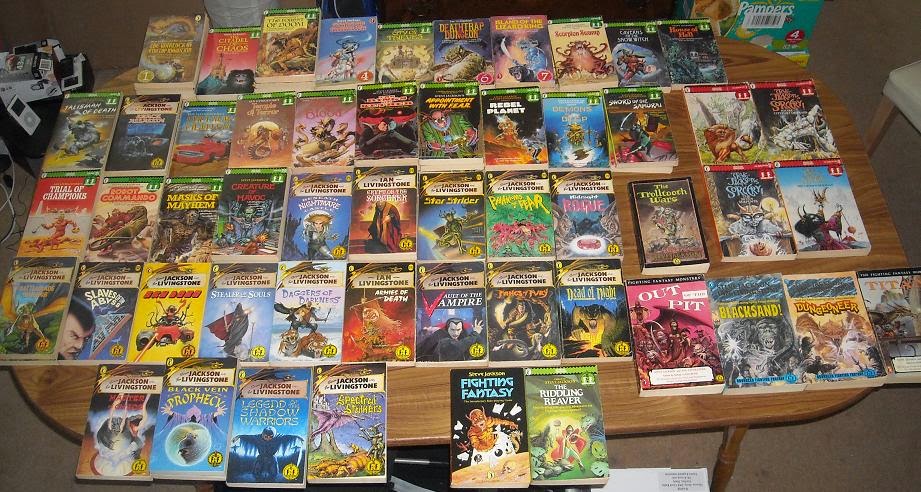
Now, I have a few duplicates, having slowly but surely added to my original collection and replaced (and replaced again) the tattier books as I buy 'job lots' from eBays, car boots, charity shops, etc. Being a rather unhealthy collector, I keep one of each cover variant - so for example I have 4 copies of The Warlock of Firetop Mountain on my shelf (plus Brett Schofield's adaptation to AFF2e). But even so, I have a few I'd like to pass on to a good home. And I'm guessing that the people reading my blog, or visiting here from Google+, are more likely to give these books a good home than the average Doncaster charity shop.

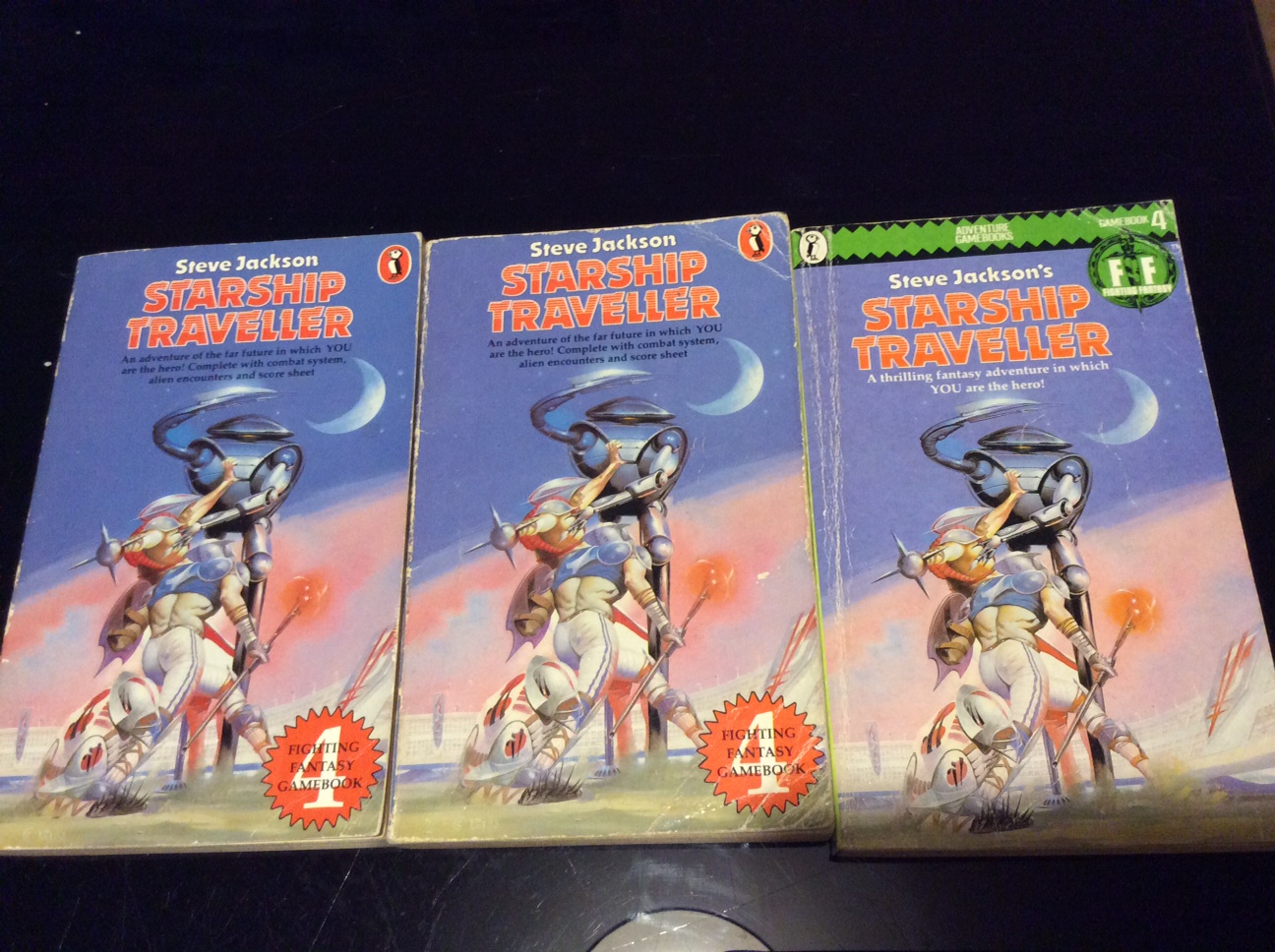
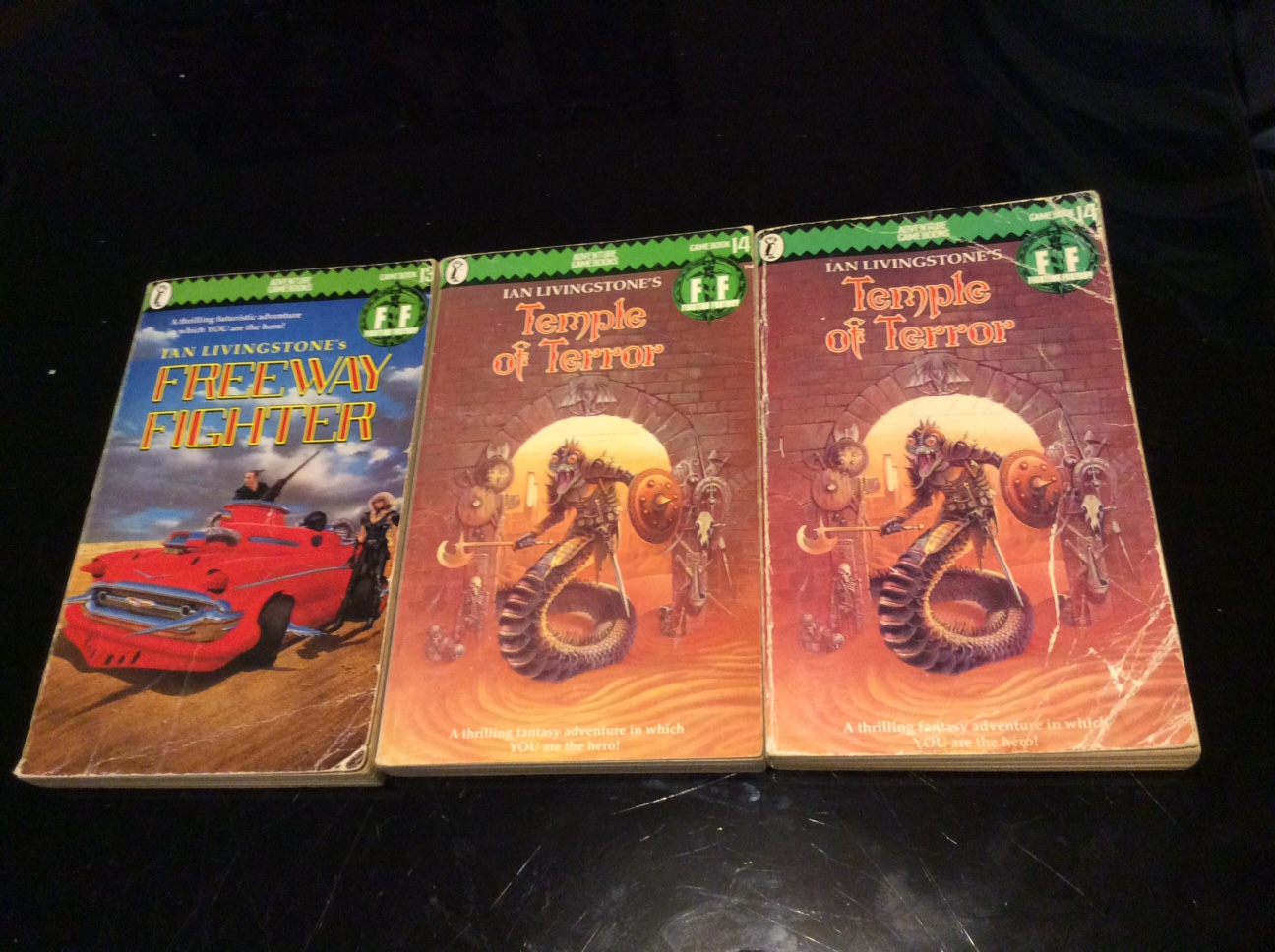
See here are what I have on offer.

[a] FF#4 Starship Traveller (Original Cover - pre-green spine) in fairly solid shape.

[b] FF#4 Starship Traveller (Original Cover - pre-green spine) a few creases on the cover but in otherwise good shape.

[c] FF#4 Starship Traveller (Jagged Green) with a some quite visible creases on the cover near the spine. OFFERED REFUGE


[d] FF#8 Scorpion Swamp (Gold Dragon) in pretty tatty shape. REHOMED

[e] FF#11 Talisman of Death (Jagged Green) solid condition, though quite yellowed pages. REHOMED

[f] FF#11 Talisman of Death (Gold Dragon) creases on the cover, but solid.


[g] FF#13 Freeway Fighter (Jagged Green) superficially tatty cover. ADOPTED

[h] FF#14 Temple of Terror (Jagged Green) a few creases on the cover. CLAIMED

[i] FF#14 Temple of Terror (Jagged Green) a really quite tatty cover.


[j] FF#15 The Rings of Kether (Jagged Green) solid, a few creases, not too yellowed. [REHOUSED]

[k] FF#17 Appointment with FEAR (Jagged Green) fairly solid shape, though a sharp crease on cover next to spine.


[l] FF#18 Rebel Planet (Jagged Green) a bit warped, superficially creased cover.

[m] FF#18 Rebel Planet (Jagged Green) solid shape though a prominent crease on the cover. ADOPTED

[n] FF#19 Demons of the Deep (Jagged Green) pretty tatty cover, but solid all the same. CLAIMED


[o] FF#25 Beneath Nightmare Castle (Gold Dragon) tatty cover with a bit of pen on it. REHOUSED

[p] FF#35 Daggers of Darkness (Gold Dragon) some creases on the cover, but none which obscure the coolest man on Titan! REHOUSED


[q] Wizard Books # 14 Armies of Death in very tatty shape, with some red ink having leaked onto the corners of the first three of so pages. Perfectly playable, with no loose pages.

[r] Wizard Books #28 Spellbreaker in as close to new condition as an unread second hand book can be. ADOPTED


And I also have a duplicate Lone Wold #4 The Chasm of Doom, with the original Sparrow Books Gary Chalk cover. Lovely, in pretty good condition. CLAIMED


THE OFFER: If you are in the UK, and want (or even need) one or more of these books, and promise to give them a good home, just get in touch on here or on Google+ and I'll post it to you. First come, first served, I'm afraid. But remember, a gamebook is for life, not just for Christmas!

Wednesday, 30 December 2015

The Temple of Sea and Sky


Also known as the Konung’s [King’s] Chapel, as it is patronised by royalty and other notables and is the seat of the Chief Godi of the cults of the brother-gods Hydana, Pangara, and Sukh. The temple is cut into a niche at the foot of the plateau upon which Vynheim is built. At high tide, the sea flows into the temple, covering the floor to between ankle and waist deep. This fills tidal pools into which worshippers make offerings to Hydana – anything from simple prayers, to treasures and up to blood sacrifice – which are carried to the deep on the next tide. The main area of worship is open to the sky, and the many tunnels and boreholes cut into the sides of the nice channel the wind. This produces a reassuring sussuration on a day of modest winds, Pangara whispering confidence to sailors, but on stormy days the temple howls with the rage of Sukh. Raiders going a-viking will often spend a night singing the battle song of Sukh before setting to sea.

There other temples, and innumerable shrines, to the Brothers of Sea and Sky, whether as a triumvirate or as individual gods, but the Konung’s Chapel is the seat of religious activity for the Northmen of Vynheim.

[Now I am settling in to my move back to my home village, my brother keeps asking me to run a game. So I will, beginning this weekend, the first of 2016. I will be setting it in Frostholm, the north-east corner of Allansia, a continent on Titan, the Fighting Fantasy world. Trouble is there is little canon to draw on for this part of Titan. Opportunity is that this allows me to cherry pick bits from Mythic Iceland for BRP, Vikings for MRQII, stuff from the TV series Vikings and The Last Kingdom, probably a bit of the Northern Reaches for D&D and the Savage North for OpenQuest, all while adding in the high-but-grotty adventuresome fantasy of Titan. So this is the Frostholm Project, which will cover the area from Sardath in the east to Bjorngrim's Sea in the west, from the Freezeblood Mountains in the north to the Sea of Pearls in the south. And anywhere else the PCs' longships take them.]

Monday, 1 December 2014

The Ballad of Xortan Throg


Every now and then I write up session reports for the games that I run. Often, weeks pass and they end up unwritten, lost like tears in the rain. This is particularly the case when I run one shots, or short adventure sequences.

Humph.

However, over the past couple of weeks we've been playing some more Advanced Fighting Fantasy 2e – the game which occupied several months of our gaming time as the party recovered the Crown of Kings [final play report here]. These games will make AFF2e it the 'most played' system for our group over the past couple of years, beating a variety of D&Ds and OSR games (even when grouped together), WFRP, and games from the d100 family. That surprised me.

As you might have seen, I have been mulling over the possibilities of AFF2e quite a bit lately ('capping effective SKILL', 'task resolution' and 'more task resolution'). Most of these are prompted by my thinking that AFF2e might be a reasonable choice for a sandbox campaign, and a wish to iron out the kinks. While I am not sure that AFF2e will beat a good ol’ B/X derived D&D variant for sheer sandbox utility (reasons partially outlined here) with super easy NPC, monster, and encounter generation (assign a SKILL and STAMINA score, and… well, not much more), and with the tools for a longer term campaign in the Heroes' Companion (holdings, hirelings, etc.), AFF2e might not be a bad choice. And, being temporarily down to two players for the moment, and only having three or maybe four even on a good day, I figured that a system in which starting PCs were already pretty accomplished would fit the need of the moment.

So, yeah, AFF2e, sandbox, player freedom, blah blah blah. And then I pluck a 'programmed adventure' – you know, a railroad – off the shelf.

Not just any adventure, though. But the adventures in Dungeoneer. And given that I have Blacksand! and the (pretty rare) Allansia I have all the material for an 'adventure path' that heavily restricts player agency. Yeah!


Nah, but surely I could subvert that, no? As the campaign develops and as the players get a sense of the world, they will develop ideas of their options outside the scene by scene[1] progression of the AFF campaign. Anyhow, a fortnight ago we played Tower of the Sorcerer, the introductory adventure from Dungeoneer. And the map looks like this:


So, yes. Not much Jacquaying going on in that dungeon, but we played it straight. And there are moments when you can really appreciate how Gascoigne and Tamlyn were introducing new players to RPGs with this adventure. Sure, there are few moments in which the players are able to exercise real choice, but aside from missing that key feature of an RPG, it can serve as a useful education.

Let me go through the 'scenes' in turn.

1. Into the Forest
The PCs are introduced to their quest as they ride through the Darkwood Forest with Prince Barinjhar of Chalice, Morval the captain of the Royal Guard, and a handful of soldiers. Plenty of exposition, delivered through conversation between Barinjhar and Morval, but in truth there isn’t much for the PCs to learn. That Xortan Throg employs Goblins, and rides a Griffon, and sometimes his agents ride Giant Lizards, okay. But anything else? Well, there isn’t much information needed as there aren’t many choices for the PCs to make, so this is largely colour. Colour provided by a haughty prince and a gruff NCO.

To justify this beginning I had Grisheart – the swashbuckling swordsman played by A – and Kumchet Wavemane – the scholarly sorcerer played by D – having agreed to take the mission while deep in their cups in a tavern only last night. They are working off their hangovers as they ride, and this explains why the mission is only being explained to them as they near Xortan Throg's tower and why they only have 11GP between them.

And the mission? Rescue Princess Sarissa of Salamonis, who was set to marry Barinjhar. Why has Xortan Throg kidnapped her? Who knows.

2. Into the Crag
So, the PCs are given the task of sneaking into Throg's tower through a cave in the base of the crag, which Barinjhar heads to the front door to parlay and distract. Here, the PCs are introduced to a semblance of dungeoneering, but in truth nothing they do matters until they arrive at a cave. In that cave, which they must cross if they wish to progress, they will be ambushed by Goblins. They will be. How many Goblins? Lots and lots. And what can the PCs do? Well, according to the book, they can pointlessly roll dice until 'each Hero has killed two or three Goblins', after which 'the rest of the Goblins flee back into their tunnels. However, the Heroes ‘are not supposed to die here', so you can have the Goblins flee sooner. 'It’s your film' [1], is the advice. In other words, there is no way for the PCs to avoid this fight, and only one permitted outcome of this fight. The players make no decisions of consequence, and the dice that the players roll don’t matter.

I despise these types of encounters. But in this case, in which the designers presume that this will be some players first ever encounter with an RPG, the purpose of this encounter is to teach the players and the 'Director' the mechanics of AFF combat.

Of course my players subverted it. A had put a point into giving Grisheart 'Language – Goblin' at character creation, and so as the Goblins came streaming from their tunnels he shouted, 'All hail Xortan Throg!' Well, let’s dig out the old D&D 2d6 (so perfect for AFF2e) Reaction Table and see what happens. Confusion, a bit of time for the PCs to make their way over the cavern. And information exchange, as Grisheart bamboozled the Goblins, who had been told to expect adventurers, with the claim that they had come to see Xortan Throg to help him with his adventurer problem. A few Provisions sweetened the deal, literally.

In truth, I was always minded to allow the players to bypass this encounter in some way, if they came up with a reasonable plan – anything but have the players play out a scene in which nothing that they do matters.

3. The Wizards Tower
This scene involves a number of encounters.

The PCs have to get past a portcullis trap, signposted by a black-red bloody smear on the floor. With careful observation (no rolls - they are looking right at the spot and asking of they see a loose flagstone) they are able to bypass the trap by simply jumping over the trigger.

The PCs will pass two doors, behind which cower peasants, broken men plucked from a nearby village for experimentation. Although the book tells the Director that the PCs will hear no sound from behind these doors, I allowed them to hear a sobbing. You have to give players some information upon which to make a decision. They picked a lock and provided some comfort to one of the wretches, his mind broken.

Then there is a Nightmare-esque sword trap, in which two giant animated hands swing swords across the corridor in quick, deadly arcs. Both Grisheart and Kumchet decided on the simplest solution, which was to use their Dodge special skill to slip past the blades. Equal or beat 14… oh, not a scratch.

Then there are two doors which present the players with an interesting choice, a choice which teaches a lesson that all players should learn. Behind these doors are the Giant Lizard and the Griffon. Now, the PCs could probably beat the Giant Lizard (SKILL 8) in combat, or even subdue it and use it as a mount. But the Griffon is a different prospect. SKILL 12, STAMINA 15 and with 2 Attacks, the Griffon would probably have done for Grisheart and Kumchet. The lesson that Gascoigne and Tamlyn are trying to teach here is this; 'You don't have to open every bloody door. If it sounds and smells like there is a big monster behind that door, and if you have been told about that big monster earlier on, well, DON’T OPEN THE DOOR!'

And that is what my, more experienced players already knew, and so we didn't have a TPK here.

Then there is a final trap, an illusory fireball. This took Grisheart and Kumchet a short while to work out, but a scrap of material torn for Kumchet’s robe was the clinching evidence.

So this scene presents a few more choices for the players to make, and lessons that it is essential that players new to RPGs learn. They have to reason their way past three traps, which will involve asking the Director for more information, interacting with the environment both as players (are there any… does it look like…) and as PCs (Kumchet tears a strip from his robe and…). This is not just a useful lesson for fantasy RPGs in which there are traps, but any RPG as the ‘description-question-description cycle’ of the 'information game' is often missed by new players who treat the first description as ‘total information’ and jump straight to statements of action.

4. The Guardroom.
Another fight, this time with an indeterminate number of Orcs and Grudthak the Ogre. Gascoigne and Tamlyn have given Grudthak some pretty decent lines, and this should teach new Directors to give their NPCs, even those that are most likely destined to die before the encounter is done, some colour. And the Orcs and Ogre are also doing something as the PCs arrive – eating a roast Goblin and gambling – which again is a good model for the new Director to follow when the come to design their own adventures. 

Grisheart and Kumchet cut down the Orcs – SKILL 5 in no time – and Grudthak politely (well, not really, he’s insulting the PCs all the time) waits until the PCs have finished with the Orcs and can gang up on him. He might be SKILL 8, but he’s no match for- KCH-ZZAP! Yep, no match for a ZAP spell causing 3d6 STAMINA damage, and so Kumchet drops to big guy just as he is warming up.

Swigging from his Potion of Stamina (ZAP costs 4 of Kumchet’s 12 STAMINA points), the doors on the far side of the guardroom swing open and a voice bids the PCs 'Welcome!'

5. The Wizard’s Chamber.
Okay, so now we have Barinjhar and Xortan Throg describe their evil plan to the PCs. Barinjhar has arranged for the disposal of Princess Sarissa so as to avoid Chalice falling under the domination of Salamonis. Fair enough, I guess, but he should have just killed her. The PCs have been hired to lend credibility to Chalice’s rescue attempt. And Xortan Throg? Well, I guess he just hates Salamonis.

Now that is one evil wizard!

Exposition over, Barinjhar leaps into the fight. At SKILL 11, he is a tough opponents, and I have given him decent armour too. Grisheart struggles – having an effective SKILL of 9 – and Kumchet helps out with some magic. Throg, meanwhile, sits and waits – unless a PC attacks him. When the PCs have dealt with the prince, it becomes clear that in the finest Fighting Fantasy traditions Throg, though exceptionally powerful, has a vulnerability. Each time that he casts his Force Bolts at the PCs, the incense burners on either side of his throne flare up. A and D are no mugs, and so charge at the incense burners, dodging Force Bolts along the way. In AFF2e Force Bolts cannot be dodged, but then who said that evil NPC magic has to work symmetrically to that used by PCs? Incense burners smashed, Grisheart and Kumchet have no problem dispatching Throg, But, whaaa-? It turns out that he was nothing more than a hollow mannequin. They rescue the princess, and to nobody's surprise, an image of Xortan Throg appears in the fireplace to vow revenge. Job done.

Post-Credits Scene: How is Tower of the Sorcerer? Well, is linear, and there is not much player choice. BUT, the adventure introduces new players and Directors to both the game mechanics and the 'information game' at the heart of RPGs. It teaches players that not every door need be opened. It shows Directors that they can add colour even to an encounter with a handful of humanoids in a square room. And in the encounter with the 'Big Bad' it presents both players and Directors with the idea that an encounter need not be resolved by the PCs lucking out on the roll of the dice, whether against a high SKILL opponent or a special skill test with negative modifiers. Indeed, resolving an encounter through dice is rather boring. But encounters can be about playing the information game then making choices that circumvent the powers of the enemy. Or whatever is the particular hazard or obstacle. Oh, and Tower of the Sorcerer can be – quite comfortably – played in an evening, an underlooked quality in a beginning RPG adventure that will involve participants who don't know the rules and who are likely unused to sustained play.

Final Credit: Grisheart and Kumchet will return in Revenge of the Sorcerer…  

[1] AFF1e's great drawback – in my view – was its insistence that an adventure in an RPG was like a film, with the Games Master being a 'Director'. Okay, there are a few mechanical issues too, but the 'RPG as film' conceit bleeds though into the advocated Games Mastering style, with advice to the Director often – but certainly not always – veering close to the negation of player agency in the pursuit of a particular 'story' outcome. 
  

Thursday, 13 November 2014

HWWJD? (more on AFF2e Skill Tests)


One of the ways to judge what kind of modifier should be applied to a Skill Test in AFF2e is to consider John of Salamonis, an ordinary human with some expertise in the task at hand (effective SKILL 7), and ask how difficult should this task be for him. As described in my last post, he has roughly a 60% of success at an unmodified Skill Test, which accords with the kind of score I usually give to a competent (but not ‘expert’) practitioner in a BRP/d100 game. Which is nice.

But let’s lay it all out in a table:
* In my own games, effective Skill for any task, including combat, is capped at 12. Achieving SKILL + Special Skill scores of greater than 12 allows Adventurers to have better chances of dealing with the kind of heroic level obstacles that impose large negative modifiers.

So, the top line gives us the modifiers that might be imposed on John of Salamonis. The second line gives us his chances of success (vs a target number of 14) as we vary the difficulty of the task. But we don’t need this level of accuracy when we are ‘eyeballing’ task difficulty. So the third line gives us his chances rounded to the nearest 10%, just as I handle BRP/d100 NPCs. As we see, this means that each extra +/-1 modifier can be imagined as adding or subtracting 10% from his chances of success. Which is nice.

Well, except for the jump from 60% to 40%, and that is fine as in my interpretation it represents the difference between an ordinary task being performed under ‘adventuring stress’ with one that has some distinct difficulties. Note that the 100s and 0s in that line represent circumstances in which John of Salamonis will only fail on a fumble (double 1s), or succeed on a critical (double 6s). Again, the actual chances are pretty close to BRP/d100s 5% fumble/critical range. Which is nice.

So when determining modifiers, rather than looking up tables mid play, I try to simply ask, ‘HWWJD?’ How Well Would John Do? If we think our competent everyman would have a 20% chance of success, we should apply a -3 modifier to the task. If we think he would succeed on anything but a fumble (double 1s), we need to give the task a +4 modifier, at least, if we bother rolling at all. And so on. These are applied to the effective SKILL of the Adventurers, which might well be greater (and sometimes, less) than 7.

I advise working out the task difficulties with John of Salamonis in mind, rather than by reference to the Adventurers’ effective SKILL. This is because if I prefer, as much as possible, to have the task difficulty fixed with regard to the fictional world – and John of Salamonis is a fixed point. If I work out task difficulty by considering the chances of Adventurers I do, unfortunately, find myself tempted to fit the world to the Adventurers. If a player has chosen to play a character with a high Sneaking Special Skill, his Adventurer should be able to achieve different things than if that player had instead created an Adventurer with a high Law Special Skill. The task difficulty should be set vs John of Salamonis, not vs Adventurer capabilities. However, the fourth line of the table does provide a guide to the chances of success broken down by effective SKILL (SKILL + Special Skill + modifiers).

(I promise to stop. Well, maybe. Most of these kind of posts are - quite obviously - me talking to myself, laying out the kind of material that I then turn into bullet points, mantras, tables etc. that end up stuck to my 'Referee Screen'. Or the bundle of notes I am using, whatever. It is intended to help me run a game more smoothly and to act as a check against me slipping into the kind of illusionism that negates player choice.)

Wednesday, 12 November 2014

Skill Rolls in AFF2e


In which I talk about the way in which I handle Skill Rolls in AFF2e, especially the ‘problem’ of what to do with low SKILL characters who are meant to be experts in a particular Special Skill. In short, don’t roll, and if you do roll, roll high unopposed.


1. Special Skill Points represent competency. This is independent of general SKILL levels. As per AFF2e p.25:
1 = Basic Training
2 = Fully Trained
3 = Expert
4+ = Master

2. Don’t roll the dice. Adventurers should succeed automatically when using Special Skills within the bounds of their competency. The dice should only be rolled when Adventurers are acting under unusual stress or attempting tasks beyond their competency. This means that an Adventurer with SKILL 5 and a Special Skill of 4 is far more able than an Adventurer with SKILL 8 and Special Skill of 1. In mundane situations, the first Adventurer will rarely be called on to roll the dice. As a ‘master’ most tasks will be within the bounds of his competency. The second Adventurer will only automatically succeed at tasks within the competency of someone with basic training. But when the situation is not mundane…

3. Roll the dice. The dice should be rolled when the situation is unusual or perilous, or when an Adventurer is attempting a task beyond their competency. In these situations there will be no difference between the chances of success enjoyed by the two adventurers described above. The Adventurer with SKILL 8 is able to make up for his lack of professional expertise in such a situation by his or her sheer grit, natural talent, ability to work under pressure, and/or downright heroism. The Adventurer with Special Skill 4 can make up for his lack of natural talent with his professional training. So, in such situations, does the Adventurer succeed or fail?

4. Does the roll beat 14?  All non-combat tasks should be resolved by rolling 2d6, adding SKILL and Special Skill, adding or subtracting any modifiers, and attempting to equal or beat 14{*}. This means that a character – let’s call him John of Salamonis – with an effective SKILL of 7 (an average human – SKILL 5/6 – with some training Special Skill 1/2) succeeds just a bit less than 60% of the time.

5. Modifiers to Effective Skill (see Capping Effective Skill)

A Legendary Feat [-8]
As an example, this is the modifier to an Awareness test if a sneaking character is invisible. This would reduce the effective SKILL of John of Salamonis, and most people and creatures of Titan, to 0. This means that, if the Referee rules the action possible at all, the chance of success is just under 3%. An Adventurer would need an unmodified effective Skill of 11 before this chance is improved (to 8%).

Almost Impossible [-6]
As an example, this is the modifier applied when fighting in darkness. This would reduce the effective SKILL of John of Salamonis to 1. Again, this means that the chances of success (vs. a target number of 14) is just 3%. However, expertise and talent tells more quickly, with Adventurers with an unmodified effective SKILL of 9 having an 8% chance, rising to nearly 17% at 10, and nearly 30% at 11.

Extremely Difficult [-4]
As an example, this is the modifier applied to Swim or Dodge tests when encumbered by a very heavy weight. This would reduce the effective SKILL of John of Salamonis to 3, which means that he has an 8% chance of success.

Difficult [-2]
As an example, this is the modifier applied with fighting while drunk. This would reduce the effective SKILL of John of Salamonis to 5, which means that he has a 30% chance of success. He will fail more often than not, but will succeeding often enough.

…er, but hang on. What about positive modifiers? What happens when things are easier than normal? In most cases, I argue that this should mean that Referee simply rules that the Adventurers succeed. Even the chances of our everyman, John of Salamonis, shoot up to over 70% with a +2 modifier, over 90% with a +4 modifier, and 97% with a +6 modifier (assuming double 1 is an automatic failure). The exception is, of course, effective SKILL in combat, in which positive modifiers do play a part (though I propose capping effective SKILL for human/mortal scale Adventurers at 12). In this case, the roll is not to beat a target number of 14, but the Attack Strength of the opponent, which can be much higher. The modifiers for combat are well detailed on p59 of AFF2e.

But note. Combat is the only place for ‘opposed rolls’ when I run AFF2e. When Adventurers are engaged in a contest vs the environment the roll is unopposed. Equal or beat 14, with modifiers for difficulty. In all non-combat contests vs NPCs, Adventurers likewise roll to beat 14, with modifiers for difficulty. I do not construct NPCs symmetrically to Adventurers. They have SKILL and STAMINA scores for combat, but their non-combat expertise is handled by key words and associated modifiers, which apply to the effective SKILL of the Adventurers, not the NPC. So, if an NPC description has that the NPC is keen eyed, I will also write that all Sneaking tests conducted against that NPC are at -2, for example. I don’t have to give him Awareness 6 to make up for a feeble SKILL score. Or the other way round – If Adventurers and NPCs are not symmetrically constructed I don’t need to worry about the effect of giving an NPC a high SKILL score – this only represents combat effectiveness, as per the original gamebooks.

It really does make statting up NPCs a piece of cake.
     

{*} The AFF2e rulebook has a suggested target number of 15, which means that there is a big difference between the default ‘roll low’ system and the alternative ‘roll high’ system. With a target number of 15 for the ‘roll high’ system, a character with effective SKILL 7 would succeed just over 40% of the time. In the default system, a character with an effective SKILL of 7 would succeed in rolling 7 or under 60% of the time.

Thursday, 28 August 2014

AFF2e House Rule – capped ‘effective’ SKILL


This isn’t going to make much sense to those of you who don’t play Advanced Fighting Fantasy 2e

In AFF2e PCs and Monsters have a SKILL score, which for PCs ranges between 4 and 12. PCs also have Special Skills, for example Sword, which range from 1-6, which are added to the SKILL score in appropriate situations. This can, eventually, produce PCs with ‘effective’ SKILL scores way beyond 12 - though a starting 'warrior' PC will likely have an effective SKILL of 9 (SKILL 7 + 2 points of Special Skill) when using his or her favoured weapons. The monsters in Out of the Pit were given SKILL scores to provide a challenge to a single gamebook PC with an SKILL score of 7-12. This means that most starting PCs geared towards fighting are at the same effective SKILL level or better than most humanoid monsters. Even a Lizard King is only SKILL 9.

Combat in AFF is resolved by generating 'Attack Strengths' by rolling 2d6 and adding effective SKILL, with the character with the higher Attack Strength doing damage to the STAMINA of the loser. Differences in effective SKILL can be understood as modifiers to the 2d6 roll; a PC with an effective SKILL of 14 has, essentially, a +7 modifier to a 2d6 roll off vs a SKILL 7 Great Orc. Modifiers have a quite dramatic effect on the distribution of results on a 2d6 bell curve, so just a few points difference in effective SKILL can settle a fight. The effect of all this is that PCs with just a few sessions' worth of Experience Points (EPs) spent on SKILL and a weapon Special Skill are BAMFs.

Now, there is nothing wrong with PCs being BAMFs. Don’t misread what I wrote in the PatheticAesthetic – I was explicit that in Fighting Fantasy gamebooks YOU are often one of the most dangerous things on Titan – there is a 1 in 6 chance YOU would have SKILL 12, after all. But YOU are always a poor decision, or a Test Your Luck, away from your doom. In an adventuring party, containing several starting characters with the combat capabilities of a Lizard King, and with characters growing progressively more powerful (neither of which is part of the original gamebooks), the PCs are at risk of outstripping the power level of the world. What I am trying to do is find a way to accommodate the BAMF that AFF2e produces while retaining the risk, danger and peril that is found in every corner of Titan over the course of a long-term campaign. And I would rather fiddle around the edges of the AFF2e system than toss out the monster stats from the brilliant Out of the Pit.


So, I’m not proposing messing with the AFF2e experience point and advancement system. Players, if they choose, can still end up with a PC with SKILL 12 and pour all their remaining EP into getting Special Skill Sword up to 6. The advice in the rulebook is that between 30-40 EP should be given to each PC for the average 3-4 hours of play. Now, while it might take 1000 EP (25+ sessions of play) to go from SKILL 7 to SKILL 12, going from Special Skill 2 to 6 is a matter of just 180 EP (5 sessions of play). So, while the effective SKILL 18 munchkin is the best part of a year of weekly play away, it is likely that combat orientated PCs will have effective SKILLs of greater than 12 within a modest number of sessions.

I am proposing that, no matter what effective SKILL score might be arrived at by adding SKILL, Special Skills and circumstantial modifiers, for the purpose of SKILL tests or generating Attack Strengths the maximum effective SKILL is capped at 12. So in a situation with no modifiers, a PC with SKILL 11 and 1 point of Special Skill Sword has an identical effective SKILL as the munchkin Sword Master with effective SKILL 18 described above. If they are fighting each other, they both roll 2d6 and add 12. Essentially, each round is a 2d6 roll off.

This means that when the Sword Master comes up against a SKILL 7 Orc, he has, in effect, +5 bonus to his Attack Strength, rather than the +11 bonus ‘uncapped’ effective SKILL would produce. This keeps combat (and Skill Tests) dangerous.

But why become a master in a Special Skill? Why spend all those EP to become a 'Skill Master'?

Because in actual game situations need not (and rarely should) be straight forward duels in perfect conditions. There are plenty of factors that can produce negative modifiers. Do note: I am applying these modifiers to the effective SKILL, not to the 2d6 roll***. This means that the Sword Master described above can take a -6 modifier and still have an effective SKILL of 12. Meanwhile, his opponent, who in perfect conditions also has an effective SKILL of 12, fights with an effective SKILL of just 6.

So, when fighting in the dungeons beneath Lord Azzur’s palace, the Sword Master can extinguish the lantern and fight in absolute darkness. This will mean, with the -6 modifier for fighting in darkness, he will still have an effective SKILL of 12. His opponent, Azzur's captain of the guard - SKILL 12 - is reduced to an effective SKILL of 6. And the simplest way to understand this at the table is to think of it as a +6 bonus to his 2d6 roll of the Sword Master. And, having defeated the captain, when fighting up the narrow spiral stairs, he can easily shrug off the -3 modifier to his effective SKILL. In other words, those with an effective SKILL of over 12 are able to cope with conditions that would defeat the ordinary man or woman (or Dwarf, Elf, or Rhinoman). 

Skill Masters can also make easier use of the combat options that apply a negative modifier to their effective SKILL. So those with an effective SKILL of over 12 can more easily go on an 'All Out Attack' (-2 to effective SKILL to add +1 to the STAMINA damage caused) or a similarly 'munchkinned' archer could fire two arrows each round using the 'Rapid Shot' option, even in poor conditions, without compromising his or her effective SKILL.

These rules should also be applied to non-combat situations. However, this is much less important for my games, as I am thinking of doing away with opposed SKILL tests in non-combat situations. I'll write about that, and the virtues of 'asymmetry' in AFF2e in my next post.

***This is an important change. Modifiers that are, as per the rulebook, assigned to the combat total/Attack Strength are instead assigned to 'effective SKILL', which is calculated before the 2d6 rolls. And as described above, differences in effective SKILL can be simplified to a simple modifier to the 2d6 roll for the character with the advantage. Now, in this system it matters whether a condition abstracted into a modifier is represented by a bonus or a 'malus' (negative modifiers). Bonuses are of little use to those with already high effective SKILL if it is capped at 12, but on the other hand they are able to absorb the effects of any malus. I wondered if, with this in mind, all modifiers should be negative (only fighting down steps, outnumbering, and a rear attack give bonuses) but I figured that I would keep positive modifiers for two reasons. One, so that I can use the table in the rulebook, and so can my players. But two, so that being outnumbered would still be a frightening experience.

For example, Six Goblins (SKILL 5) attacking a Sword Master would each have an effective SKILL 10 (+1 for each extra opponent). The Sword Master would still fight at effective SKILL 12 (effectively a +2 bonus to the 2d6 roll), and could 'spend' up to 6 'points' in 'All Out Attack', or find other ways to apply negative modifiers to the effective SKILL of all combatants, in order to make use of his supreme munchkinned mastery. By comparison if outnumbering was abstracted into a 'malus', the Sword Master would still have an effective SKILL of 12, and the Goblins would each have an effective SKILL of 5, effectively giving the Sword Master a +7 bonus to his roll (and that is with 'effective SKILL capping) making for a far less interesting situation.

FINAL NOTE: Only PCs have their effective SKILL capped at 12. Monsters in Out of the Pit with a SKILL of greater than 12 are not capped in this way. These kind of monsters are rare indeed, being Demons, Elementals, Dragons and the like (even Giants are 'just' SKILL 10). Human(oid) PCs are not meant to beat these creatures in a straight stand-up fight, and indeed in the source material YOU are rarely expected to do so. The key is always to find the MacGuffin, the special weakness, or come up with a cunning plan to circumvent the sheer power of these monsters.