








No animal is half so vile as Crockywock the Crocodile...
A long time ago I read a news story which reported that a drunk Australian had tried to ride a 5m long crocodile weighing 800kg. He survived, if he was a little chewed. That prompted me to set about searching the internet for pictures to put that croc into context.
And, my...
And, my...

Imagine trying to take one of these on with a sword and shield while knee deep in swamp water?
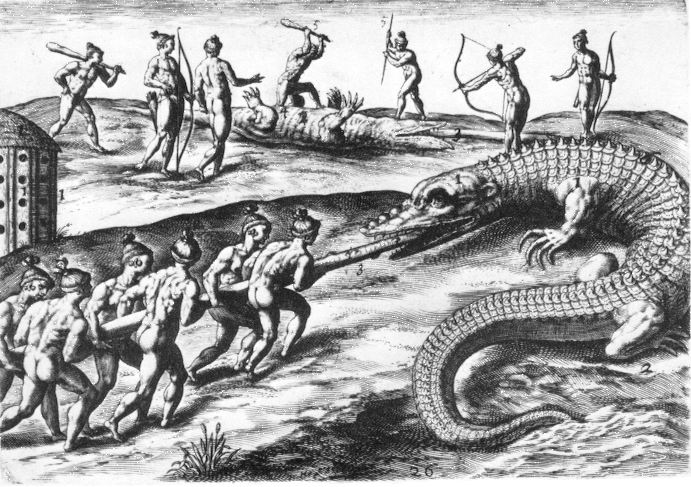
Bring hirelings!
In classic D&D (Mentzer Expert, absolutely my favourite D&D book), a Normal Crocodile is a 2HD creature, averaging at 9HP, doing 1-8 damage per bite. A Large Crocodile, which I guess encompasses the maximum size we find in the real world, is a 6HD creature, averaging at 27HP, doing 2-16 damage per bite. There is also a Giant Crocodile of explicitly prehistoric proportions, but that is beyond what we're talking about here.
A D&D Fighter, remember, will have on average slightly more HP than a monster of equivalent HD to his level - he'll likely have a bonus from Constitution, some kind of minimum HP house rule, or outright fudged dice!
A D&D Fighter, remember, will have on average slightly more HP than a monster of equivalent HD to his level - he'll likely have a bonus from Constitution, some kind of minimum HP house rule, or outright fudged dice!
In Magic World (which takes its bestiary from the RuneQuest Monsters book for the third edition of the game, rogue Fatigue Points and all!), the Small Crocodile has 23HP and does 1D10+2D6 damage per bite, while a Large Crocodile has 40HP and does 1D10+5D6 damage per bite.
A Magic World warrior will have perhaps 15HP... full stop.
Big beasts are more frightening in d100 games. But then the play-style in D&D ought be at least a little different from BRP-derived games - certainly where combat is concerned. I was going to write a long post comparing chances to hit, calculating average damage by round, and then I realised that I would end up doing something as boring as the old Monstermark articles in White Dwarf!
So I will short cut all that. I like games in which big beasts are dangerous. But big beasts in D&D *are* dangerous - though I often have to remind myself of the fundamentally abstract nature of D&D combat (and I always need to hold in check my desire for realism and granularity in D&D combat) which means that comparisons with blow-by-blow systems are not always straightforward. But for all the Crockywoks in your game, FANTASY gaming needs DRAGONS. While we shouldn't forget the terrors of 'ordinary' animals (though in a world created, deliberately, by supernatural beings, even ordinary creatures are the product of a god's violent imagination), let's have some bright, primary-coloured fantasy to mix with our realistic shades of green and brown.
A Magic World warrior will have perhaps 15HP... full stop.
Big beasts are more frightening in d100 games. But then the play-style in D&D ought be at least a little different from BRP-derived games - certainly where combat is concerned. I was going to write a long post comparing chances to hit, calculating average damage by round, and then I realised that I would end up doing something as boring as the old Monstermark articles in White Dwarf!
So I will short cut all that. I like games in which big beasts are dangerous. But big beasts in D&D *are* dangerous - though I often have to remind myself of the fundamentally abstract nature of D&D combat (and I always need to hold in check my desire for realism and granularity in D&D combat) which means that comparisons with blow-by-blow systems are not always straightforward. But for all the Crockywoks in your game, FANTASY gaming needs DRAGONS. While we shouldn't forget the terrors of 'ordinary' animals (though in a world created, deliberately, by supernatural beings, even ordinary creatures are the product of a god's violent imagination), let's have some bright, primary-coloured fantasy to mix with our realistic shades of green and brown.


