Showing posts with label Runequest. Show all posts

Tuesday, 12 August 2014

Contrary as usual


So, we all know by now that there is this new version of an old game out. By all accounts it is pretty good, combining the best parts of the older editions with some new thinking, before streamlining the whole thing to produce a game that plays much like the traditional editions while having the modern chrome required to attract new fans. And surely we also all know that while you can buy an expensive, well produced hardcopy version of the rules, there is also a free .pdf of the core of the rules - the basics, or essentials if you will, that put a perfectly playable version of the game in your hands.

Download the free pdf of RQ6 Essentials
And with this one, I don't think that anyone could moan about the cover art.

Wednesday, 18 June 2014

RuneQuest 6 for Free! (and some thoughts on player competency)


RuneQuest 6 is a masterpiece. In my judgement, it is just too much system for the group that I play with, and for our play-style, but I can't help but admire the elegance of the system, the quality of the writing, and the physical book itself – I own the hardcover with slipcase. I also own Monster Island, the Book of Quests, and will no doubt continue to buy RQ6 stuff almost as quickly as the Design Mechanism can churn it out. I am very much looking forward to Mythic Britain.


 RQ6 is too much for our group, I said. BUT…

But RuneQuest Essentials has now been released as a FREE resource. You can get it directly from the Design Mechanism HERE. 200 or so pages containing, well, everything that a player needs to play competently. Perhaps this summer, when D is back in town and we are able to put some time into face-to-face play, we could reconsider RQ6. I still, as always, worry that book-keeping crunch and systems with too many moving parts are enemies of the kind of freedom that I value in roleplaying games, which is why B/X and its derivatives are my go-to games. And it'll have to jostle for position with some other games demanding my attention for our summer game (WFRP1e, Classic Traveller, etc. etc.). BUT...
 
But I have more to say on the subject of player competency. I tend to shy away from games that require any great degree of system mastery on the part of the players in order for them to play 'well'. It is one of the reasons that I don't like later D&Ds – it appeared to me that understanding the system was essential if a player was to make good choices, from character creation to the 'synergistic' use of feats, powers, and magic. I prefer systems in which the players can make effective choices on the part of their characters without needing any deep understanding of the mechanics that will be used to resolve the actions. Of course, you can’t avoid some system 'intrusion', but the system would ideally be one that a new player could sit down at the table and grok in their first session. D100 games, with their intuitive roll-under mechanism expressed as a percentage, are good for this. At least until you get to magic - and magic is the barrier to ‘player competency’ in almost all fantasy RPGs as it often cannot be understood simply by reference to real life and the [non-mechanical] ‘fiction’. Which is one reason, beyond the aesthetic, why I prefer relatively low-magic games...

Now, magic in RQ6 contains more moving parts than my usual system of choice. But that is a player competency issue I expect and just have to live with. My worry re: player competency in RQ6 is the admittedly beautiful combat system. Will a character with a low score in their Combat Style, but controlled by an experienced player, beat a character with a high score controlled by a novice? Yes, or at least he has a chance. In a D&Dish game a high skill fighter (as defined by level) has the same chance of beating a low skill fighter regardless of the players involved. This might sound like a bad thing, but it is not. It is part of the ‘simulation’ of the world – the player choices with regard to his or her character are not about what type of stroke to make with your sword, or what part of your body the shield will cover. The level 5 fighter knows this, and he knows it better than the level 1 fighter - and this competency is abstracted into the mechanics of D&D combat. The choices that a player makes are about when to engage in combat, on what terms, in what circumstances, etc. The larger-scale decisions, the strategic decisions, are the province of the players, and these can be made in the context of the game world, requiring little system mastery.

But the more granular the decision making is, the more it will expose the mechanics, and thus it will require greater system mastery in order to play 'well'. In RQ6 the experienced player will have a better understanding of which Special Effects to apply in which circumstances. he or she will understand how these Special Effects interact with Resistance Skills and the Combat Action cycle/economy. For a skill-based game - which traditionally default to the character sheet to deal with the question of player/character competency - this creates a curious ‘break’ in the conceptualisation of player skill. So you don't need to actually be a great diplomat, as you have Oratory and Influence Skills of over 100%. Sure, you might need to know when to apply these skills, but those decisions are taken at the strategic level, and the level of system mastery required is little more than; "oh, my character is a master orator, so I'll get up on the steps of the forum and try to incite the crowd with tales of the debauchery of the noble classes", i.e. playing well comes down to engaging with the game world, not engaging with the system.  

All that said, despite my worry that the granularity of the system is such that player decisions are being taken at the ‘wrong’ level, the combat system is a fantastic game in its own right, and the Special Effect system produces some lovely, easy to narrate battles. And it is FREE, so cheap at twice the price!

Friday, 2 May 2014

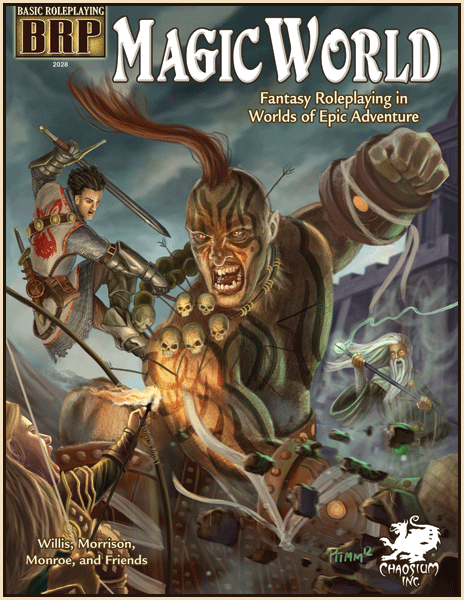
Some Thoughts on Magic World


We recently played quite a few sessions of Magic World, Chaosium's update/compilation of its BRP fantasy rules (Elric!, with a bit of RQIII squeezed in there too). We enjoyed playing it, using it to run a brief sandbox game based around Salamonis in the Fighting Fantasy world of Titan. I have a few thoughts on the system:


1.    I like the combat system. This is no surprise, as it is basically the Elric! system, which is very smooth and quick to run, while at the same time retaining plenty of texture, mostly by way of a large number of 'spot rules' that handle things such as disarming or knockout blows, variable weapon length etc. Variable armour adds another dice roll when compared to most games, but it is a simple one that adds to the drama of combat, and using total hit points rather than hit locations allows for easy bookkeeping. The major wound system can provide plenty of specific and 'colourful' injuries, all the same.

2.    There are too many skills. This is particularly noticeable in the case of the 'physical' and 'perception' skills, groups of skills that, to my mind are so interrelated that skill in one should almost always accompany skill in (some of) the others. In terms of 'perception', Magic World has Insight, Listen, Sense, Search, and Track, plus other 'information' skills such as World Lore, Evaluate, etc. It is a weakness of my Refereeing style that I have a hard enough time running a game with a single 'perception' skill. If these kind of skills are going to mean anything in the game, the Referee must 'gate' important information not by player decisions but by character skill. If a PC has Sense at 90% (as was the case in our game), the Player must get the sense (ugh) that such a skill is as mechanically meaningful as having Sword at 90%. Whether a PC has Sword at 90% or 60% or 30% determines her chances of defeating the Baron's Champion. If we are going to have perception skills, the percentile rating should determine the chances of the Player being given information that will allow them to make better decisions. Oh, I know I am hashing out old territory here…

But it is not just the types of skills, but the granularity. The fact that competency in these closely related skills is not related, which leads me to…

3.    I like the way combat skills are handled (but…). In Magic World there are weapon groups, which encompass all weapons of a particular type. Skill with one weapon in a group = skill in all other weapons in that group. This skill is used for both attacks and parries. This is a nice middle ground between the extreme granularity of Chaosium RQ with skills for each individual weapon and separate parry skills, and the broad strokes 'styles' of  MRQII and RQ6 and the 'close combat / ranged combat / unarmed combat' split of OpenQuest. But then, if I’m going to enjoy this level of granularity for combat, for the sake of consistency shouldn't I accept a similar level of differentiation for 'perception skills', or for the eight (yes, 8!) physical skills? Perhaps, I should, and here you can see how my preferences waver between the granularity of Magic World and the condensed skill list of OQ.

4.    I don't like the fact that the equipment list is all out of whack. Who would. That's not a taste thing. The Bronze economy appears to make little sense. The weapon groups on the table are all over the place, but this is easily fixed by reference to the table describing what ought to be in each group. But this does cause one to lose confidence that the other numbers on the table reflect the intent of the designers. Should the STR/DEX requirements be that high? Should this weapon really do more damage than that one? Should a falchion really be that expensive? I own Elric!, and so could do a comparison, but actually, when I run Magic World again, and I shall, I will most likely dump the entire equipment section and replace it with a bespoke list, likely derived from Arms of Legend.

5.    Character creation is great! Quick and simple, but without losing the distinctive customizability of a BRP game. Players don’t simply have a pool of points to distribute as they see fit, which leads analysis paralysis as they pinch a percentage point here and there, tinkering with details that drag out character creation for little gain. Rather, they have blocks of points based on their culture and prior occupation, rather like Peter Maranci's Skill Pyramid. Players simply have to decide which of the listed occupational skills they want to be best at, which they want to be good at, and with which skills they want some competency. The, as default, limited magic helps speed up character creation, too. Which leads me to…

6.    Magic. By default, only characters with a POW of 16 or more can use magic. If Players are randomly rolling their characteristics, this means that magic using characters will be pretty rare, unless they make a grim bargain and begin trading away their other characteristics in the pursuit of magical power. I'm pretty happy with that – it matches the tone that my fantasy worlds, regardless of starting point, eventually take. And with magic as a power limited to just a handful of people it means that the assumptions of the game are roughly compatible with the assumptions behind most (D&Dish/’vanilla’) fantasy worlds.

There is only one type of magic in Magic World (barring Advanced Sorcery, or plugging in the Unknown East for Elric!, or the BRP Magic Book, or stuff from the BGB, or, or, or...). But, actually, that’s not quite true. There is only one mechanic for handling magic in Magic World. But that doesn’t stop a Referee creating a specialist spell lists for different types of magicians and magic users, changing the flavour text and so on. And it is certainly easier to do this than to grokk and incorporate the mechanically distinct magic systems in RQ6. 

This is not a review. But here’s something like the conclusion to a review: In a nutshell, the disappointments that I have with Magic World are largely a back-handed compliment; while I wanted a clean, revamped Elric!, Magic World appears a bit undercooked, perhaps because Chaosium haven’t backed the game with any great gusto. Which probably makes business sense – who wants to put too much of their resources into a competition with Legend (the $1 OGL D100 game!), RQ6 (a game of supreme polish), and OQ2 (the quickest and easiest system for running D100 fantasy, and it is OGL too!)? I don’t expect Chaosium to invest great resources into fighting a losing battle because it’ll please my idiosyncratic desires for a relatively low magic D100 game of medium crunch that uses the resistance table! But I’m glad that they let Ben Monroe resurrect the Elric! system, and hope that Magic World releases are part of the BRP catalogue for some time to come.

But update the .pdf with the errata, already!  

Monday, 3 March 2014

Melange


Not something collected from Sand Worms, but a description of the patchwork of rules in play at my table during last week's session. The Party had found the Skin Mandala, were found by a little trouble in Salamonis (I should write up those session reports), and were then recruited by the King's spymaster to ensure that the trouble brewing between the local Goblin tribes (trouble likely caused by some unprovoked murder-hoboism by the Party) was turned to Salamonis' advantage. The reward was membership of the Order of the Brass Sceptre, a minor 'knightly' order populated by merchants and professors, but nevertheless a step into Salamonis society. 

The players were given some brief details on five local Goblin tribes, their customs and allegiances, and decided that the Party would begin by visiting the savage Moondance Goblins of the Forest of Spiders. The plan is still nebulous, but seems to be getting towards, 'unite the Goblins and sack Salamonis'. Indeed!

But in the sort term, that means a bit of a wilderness crawl. Out came the numbered hex paper and the index cards, and I started generating interesting encounters in and around the Forest of Spiders. Giant Spiders. Zharradan Marr's Rhino-Men and Soulless Ones. Mundane animals. Trees festooned with gory charms. Sinkholes of corruption. A village of Sprites. Etc. 

Now, on the table there were three d100 rule-books; Magic World (which we're using), RuneQuest 6, which is filled with interesting stuff, and OpenQuest 2, which has tended to be my go to d100 bestiary. Also on the table were Titan, Out of the Pit, and Advanced Fighting Fantasy 2e, to provide me with quick setting reference when I didn't just make it up. But that I resorted to using the next two books is something that I found quite surprising. In play, I referred both to Menzter Basic and Expert D&D. From the Basic D&D DM's book I took guidelines of 'monster' reactions and handling morale. From the Expert D&D book I took the procedures for wilderness exploration - getting lost, random encounters, and so on.

It made me realise just how much, as a DM, I value the D&D 'procedural game'. I've been meaning to write a proper blog post extolling the virtues of D&D's abstract, procedural (but simple) systems, so we can add that post to the list of things that I have promised to do. In the meantime, who else indulges in a cross-system melange? 

Wednesday, 18 December 2013

A Gift from Dave Morris - Silent Night


Dave Morris has provided everyone with a Christmas present; a detailed, atmospheric, Yule-themed adventure - Silent Night. If possible, I plan to run it while we're away over the holiday. 

Yippee! It's Christmas! Let's Danse.

I'll have convert it - it is written up for GURPS, with which I have zero familiarity*[1]. But to what? To Dragon Warriors? The adventure is set in Legend, after all. And that is a possibility - I actually think that Dragon Warriors is a pretty nifty system for handling gritty D&Dish games. But unless you are going to populate the PC party with a bunch of magic using characters, or exotic Assassins, mechanically the PC Knights (and maybe a Barbarian or two) will be pretty much the same. That's fine in a game where character, personality, and history emerges through play. But for this one shot - that is not so much focused on combat - it is more likely I will try to run it in a d100 system, considering OpenQuest 2e, RuneQuest 6, and Magic World. 

As attracted as I am to RQ6 - it is a wonderful, elegant iteration of d100 fantasy - the players will be my wife, brother, sister, mother, and cousin. That's Christmas for you. While they all have played RPGs before, it'll need to be straightforward pick-up-and-play. When I started to stat-up some pregenerated characters in RQ6, I realised that the character sheet would likely baffle a player being handed the sheet ten minutes before the game begins. Plus, we'd have the confusion over Special Effects, which are a breeze... once you have been involved in combat as few times. So I decided that I'd run it using OpenQuest 2e, which won out over Magic World thanks to the rationalised skill list and the greater versatility of the magic system.*[2] 

The players will have the choice of the following pregenerated characters:

Sir Werian Keppel
A knight, returning from the Crusades. Pious. Uncomplicated.

Brother Abel
Werian's personal priest and tutor. Impatient. Stern.

Hugh Smithson
Werian's squire. Hulking. Brutish.

Alan of Barndale
Troubador. Cynical. Flippant.

Soliman the Saintly
A Ta'ashim convert to the True Faith. Self-taught theologian and Ellesland-ophile.

Nick Lliedr
A greedy rogue. But has a knack for solving problems.

I will be trawling the internet for suitable images with which to decorate the character sheets, and thinking carefully about the place of Battle Magic in a game with the atmosphere of a fantastical Dark Ages/Early Medieval Britain.

*[1]Gurps intimidates me. Even GURPS Lite sends me running for the hills... while I can see the appeal, I can't see it being the kind of game that I could interest our players in.
*[2]In other circumstances I might well make a different choice. With strong player commitment, RQ6 would edge closer to being my choice, while Magic World is a good for Sword & Sorcery thanks to the way that magic using PCs will, by the book, be uncommon. 

Monday, 4 November 2013

One Hundred Percent Yes


Newt's lovely looking OpenQuest 2e

After The Crown of Kings concludes (probably tonight, with our face-to-face group convening over Google+ - except for my wife, who I hope will join me at the table rather than play from the next room on her laptop), I'm increasingly drawn to the idea that our next game involve plenty of percentile dice. Thing is, as well as several out of print d100 fantasy games, I own OpenQuest, RuneQuest 6, and Magic World to draw from. I've also got the in-print Legend, but if I'm going to play that, why not just play RQ6? That's not to say that YOU shouldn't play Legend at is $24 cheaper (or one 25th the price...), but given that I own RQ6 (plus lots of MRQII books), I may as well play the 'refined' version. 

I know that the *right* answer is to take the best bits from each, and build my own game, but I do like being able to run a game from a single book - or at least, a small number of directly comparable books. 

I like OQ2e for its simple but comprehensive skill list and the way that the game runs smoothly at the table, with next to no fiddling about. I like MW for its character creation, which uses 'culture' and 'profession', providing a bit more flavour than OQ2e, but avoids the extended chargen process of RQ6 by allocating the skill points so neatly - in good sized blocks - that generating a PC is almost a quick as it is in OQ2e. Actually, it does what I was trying to do with my 'Hammerstein!' templates, but far, far more neatly. I like RQ6 for its elegant combat system (to what degree would using some variant of that break the simplicity of OQ?). Can all these be shoved together? Is it worth bothering, or should I just run a game straight from the book?

And where to play, one which worlds....

Monday, 14 October 2013

"An adventure area should provide....


...the player [character] with the following opportunities:

- experience in the use of his skills
- opportunity to obtain treasure and thereby purchase further training
- the chance to die in the pursuit of the above
- enjoyment while doing all of the above"

From RuneQuest 2 (1980)

Thursday, 25 April 2013

A Hundredweight of d100 Fantasy


I bought (.pdf, have you seen the shipping costs that Chaosium quote for transatlantic shipping?!) the new version of Magic World, which is basically a reprint of Elric! stripped of it Moorcockisms. And very nice it looks too; a clean, relatively simple d100 fantasy game. The first supplement, Advanced Sorcery, is due soon - again it is largely a reprint of Elric! material, in this case The Bronze Grimoire. 

Chaosium should note* that they are selling .pdfs of Elric! on DriveThruRPG for a couple of quid cheaper, at current exchange rates, than Magic World. And, of course, that nothing short of free is quite a cheap as Legend, which itself is basically a reprint of Mongoose RuneQuest II stripped of its Gloranthaisms. And speaking of Elric, with Legend you could run the Mongoose version of everyone's favourite albino (outside the one played by Mel Smith in The Princess Bride), as all(?) their Elric of Melnibone stuff is on DriveThruRPG for less than £10 a book...

But as Brian Butterfield would say, "that's not all". So, what do we have on the d100 fantasy scene at the moment? Well, we have OpenQuest 2e on the way (I backed the IndieGoGo campaign, and am looking forward to seeing the improvements/additions that Newt Newport has made to this system). Slightly more complex than that, we have Magic World from Chaosium. An extra level of complexity is added - mainly by virtue of its 'faction' system - by Renaissance (now available in a Deluxe form), built on OpenQuest and Legend. One level more complex again is Legend, with its Combat Action 'economy' and system of Combat Manoeuvers  And then we have the big boss of d100 fantasy gaming, RuneQuest 6, which I haven't had a chance to look at yet, though I expect it to be stunning, if I bit too much for my current tastes. 

I own OpenQuest (and soon will have a copy of 2e), Magic World, Mongoose RuneQuest II and Legend, and Renaissance (in the free SRD and hardback Clockwork and Chivalry 2e form). I also own the Basic Roleplaying 'big gold book', will probably buy RuneQuest 6 if it ever appears with a UK supplier, and have a number of out-of-print d100 fantasy systems (I particularly like my GW-produced RQ3 books). With all these extant systems, and given the fact that many of them are OGL (and those that are not appear keen to licence third parties to produce supplements), this is a vibrant, lively time for d100 fantasy gaming.

Well, if there are many other gamers are as daft as me, willing will buy umpteen different versions of d100 fantasy, of course the d100 scene is vibrant! I can't quite decide which is my favourite d100 engine for fantasy gaming (which is yours?). "No, really?", I hear you say, shocked. "I had no idea that you suffered from gamer ADHD", you gasp. However, the intercompatibility of these systems - and the nature of the d100 system itself - not only its modularity, but the simplicity and consistency of the mechanics - means that GMs can pick and choose the best bits from each of these systems. Sadly(?), between Magic World, OpenQuest, and Renaissance, there is little need for Hammerstein! as yet another d100 system. But hopefully this flowering of d100 fantasy systems will stimulate the production of d100 fantasy adventures and other supplements for use at the table. 

*Hopefully, if Chaosium did take note (though given that they don't even notice e-mails, it seems) I'd hope this would not mean an end to the sale of the classic Stormbringer/Elric! .pdfs - we wouldn't accept other kinds of books being deliberately kept out-of-print, and the resurrection of out-of-print gaming books is one of the great success stories of recent RPG history - or an increase in their price, but rather a more reasonable .pdf pricing structure at Chaosium.com.

[Extra: Of course, this is not the limit to d100 fantasy built on a BRP(ish) chassis. In the pipeline are both AEONS, built on the D100II SRD, and Classic Fantasy (originally a BRP supplement) is being rewritten as a 'Legend compatible' complete game.]

Thursday, 20 December 2012

On Ability Scores (2)


More stuff that everyone and their dog has written about before:

In the last post I said that most NPCs in D&D should not have ability scores. By this, I don't mean that we shouldn't bother writing them down, I mean that they should not have them at all. Ability scores in D&D are not the same as characteristics in RuneQuest (RQ). In RQ, every living thing is statted out just like a PC because in RQ characteristics are a measure of something ‘real’. A Dragon’s STR can be compared directly to that of a PC. In D&D monsters do not have ability scores. If a monster needs only a bare stat line, so does an NPC, though they might have rich, complex histories and personalities.

In most versions of D&D, education does not raise INT, weight training does not raise STR, an improved diet does not raise CON. One of the weaknesses of thinking about D&D ability scores as a measure of something ‘real’ in the game world is that if, for example, we rationalising low CON as being the result of a PC’s obesity, a PCs CON score should be pretty mutable, changing with diet and exercise. If we treat D&D ability scores as representations of a Platonic ideal of the PC, the CON score will remain the same for the entire life of the PC. We might change the PC’s ability score modifiers though...

Thursday, 26 July 2012

Indiegogogogogogo


I've recently gone in on a few Indiegogo campaigns. I went in on James Raggi's Lamentations of the Flame Princess hardcover campaign, which was funded along with one stretch goal. However, by the appearences of Raggi's next campaign, he's failed his Sanity check. 19 inter-related campaigns, each needing $6,000 of funding to run, but with the perks for big pledges dependant on other campaigns being funded (i.e. pledge $20 for the print+pdf copy of the adventure = no risk // pledge $100 for the print+pdf of this adventure and up to five others = $120 of books, maximum, but very likely much less). Crazy. Nevertheless, it looks like some will fund, with Jeff Rients' Broodmother Sky Fortress currently just shy of the $6,000 mark.


Award-winning (it counts, doesn't it?) adventure designer Kelvin Green has an adventure in the crazy campaign - Horror Among Thieves. I've contributed to this campaign. And, remember, James Raggi has failed his Sanity check, so:


There's just 6 days to go on these campaigns.

But that's not all. Graeme Bottley, re-animator of Advanced Fighting Fantasy, has an Indiegogo campaign running, to fund not only the republication of the classic Blacksand book, but its expansion. With just a $3,000 target, and well over a month remaining, this looks like it is almost certain to meet its target. Now, I've gone for the softcover, but if you're a fan of big beautiful books, higher contribution levels might well get you something special.

And finally, the Indiegogo campaign for OpenQuest Remastered / OpenQuest 2 will go live very soon. Another campaign well worth funding.


Tuesday, 10 July 2012

Folk Magic in Hammerstein!


It is too easy to allow magic in D&D become bland. There is no casting roll, no consequences for magic use, and spells occur instantly (if you win the initiative roll). I did like AD&D2e's casting times and material components, but never actually used them in play. The 2e schools of magic and specialist wizards were a good idea, even if they didn't work that well [to my mind, Brendan at Untimately has a much better way of handling 'specialist' magic in D&D]. RuneQuest magic can play pretty vanilla too, especially Common Magic, though the attempt by RuneQuest to embed magic in the cultures of the fantasy world - into the very fabric of the world, in the case of Glorantha - sets it apart. WFRP1e gives you magic with material components, and promises a world in which magic is a dangerous force, but unless a character opts for the dead-ends of Necromancy or Demonology, it is actually quite a low risk pursuit. What I am attempting to do with Hammerstein! is to tinker with the OpenQuest magic systems to produce some appropriately flavourful effects. First, by way of the RuneQuest lineage, magic is easily tied to the social organisation of the world - cultures and cults, guilds and grimoires, etc. Second, while magic will be ubiquitous, most people will have little magical power - Folk Magic (Common Magic/Battle Magic in Hammerstein!) is increasingly harder to learn at higher magnitudes. It is the magic of simple charms and curses, ritualised gestures and chants, echoes of lost knowledge. Third, other, more powerful forms of magic - supernatural intercession and thaumaturgic sorcery - carry risks. Communing with the supernatural is exhausting - so we're talking Resilience tests with Fatigue and even Hit Point penalties. Understanding the magical nature or reality is mindbending - so we're talking Persistence tests with Insanity Points. Or somesuch - I've yet to decide whether to use OpenQuest's elegantly simple rules, or build something pointlessly complex on top...

It's enough to drive you mad!


Anyway, there's more to it than that. With Folk Magic, I'm adding in 'material foci'. Below, I try to explain what these are, and suggest material foci for the OpenQuest spells that I'm including in Folk Magic. Of course, players will be free to suggest that their character comes from a tradition in which object X is used to cast folk magic spell Y. But the examples will set the tone. Unfortunately, the material foci that I've come up with are boringly literal. Suggestions for other material foci are welcome. Very welcome.


[6.2.3.1] Material Foci
Casting folk magic spells usually involves the use of a material focus. These foci are as variable as the traditions through which this form of magic is passed from generation to generation. More often than not, the material focus of a spell is not consumed by its casting; it is simply a prop around which the ritual has been taught. A character casting a folk magic spell without the material focus used in the tradition he was taught does so with a Difficult (-20%) modifier to his Folk Magic skill score. Characters with very high Folk Magic skill scores are able to dispense with material foci as their mastery of the ritual is sufficient, but for the day-to-day practitioners, holy symbols, pinches of salt, feathers and the like are essential elements of magic. 

[…]

Befuddle 
A small pouch of tiles or pebbles painted or carved with letters. 

Clear Path 
An ordinary knife.  

Co-ordination 
A toy top, a feather, an accurate set of weights, or extract of monkey brains.

Countermagic 
A necklace, a bracelet, or a ring of other warding charm.  

Darkwall 
A pot of tar, a falconry hood, or a candle snuffer. 

Demoralise 
A toy mask with exaggeratedly fearful facial features or a small bag of live spiders. 

Detect (X) 
A small piece of the substance to be detected, a compass with the needle removed, or a dowsing rod. 

Dispel Magic 
A bag of salt, a pinch of which is tossed into the air when the spell is cast. 

Disruption 
A strip of leather, squeezed or pulled, as the spell is cast.

Dull Weapon
Two pebbles, ground together in the hand as the spell is cast.

Enhance (Skill)
The material foci for these spells are highly variable, ranging from trade tools to guild symbols, to material with a symbolic of mythic resonance with the skill being enhanced.

Extinguish 
An ordinary container of water.

Fanaticism 
The teeth or claws of a vicious beast.

Firearrow
A piece of amber, touched against the missile.

Fireblade 
A piece of amber, slid against the blade. 

Heal 
Heal spells are unusual in that they often do not require a material foci, though some traditions build their rituals around the use of a holy symbol.

Hinder (Skill)
The material foci for these spells are highly variable. Guild symbols are often used, though many guilds deny that they teach such magic to their members.   
Examples:
Hinder Perception – a pinch of dust blown in the direction of the target.
Hinder Trade – common material foci include counterfeit coins, rigged weights, and other symbolically fraudulent measures.
Hinder Persistence – spilling strong drink or a sedative drug onto the floor often serves as the material focus.

Ignite 
Pieces of flint or a small pouch of ashes.

Light 
This spell needs no other material foci other than the object to be illuminated. 

Mindspeech 
A small piece of paper covered in writing, which the caster swallows. 

Mobility 
A feather.

Multimissile 
Archers using this spell often use a bag of down as the material focus of this spell. Cultures that use slings often use a handful of sand. The javelin wielding tribesmen of Inner Pogotania use a small bundle of reeds. Interestingly, though these traditions reflect the missile weapons of the culture, a Pogotanian tribesman can cast Multimissile on the crossbow bolt used by a Genezian mercenary perfectly well.   

Pierce 
A steel or bone needle.

Protection 
The material foci of these spells are often simply the clothing, armour, weapon or shield of the target. The Allmeny barbarians, who eschew armour, often smear themselves in Frazetta oil when casting this spell.  

Second Sight 
The material focus of this spell is often a ring, to be looked through when casting the spell. 

Slow 
A pouch of stones or lead shot, or a jar or treacle.

Speedart 
Tools for measuring distance, such a ruler or a knotted string. 

Strength 
The knuckle bones of Trolls and other large humanoids or a mouthful of bull’s blood. In some barbarian tribes, the passage to manhood involves receiving a thick leather belt that acts as the focus of this spell.

Vigour 
Strong liquor or hot spices.

Water Breath 
Traditional material foci among the fishing villages along the Dragon’s Back include swallowing dried fish gills, while the Pearl Islanders take a small breath from a pouch made out of a swim bladder.  

Weapon Enhance
Blood from a man or woman who died in combat. Soldiers in the armies of Genezia are trained to use the gold doubloon that they received when being commissioned or conscripted.


Wednesday, 2 May 2012

RuneQuest 6 preview available


Having just received a bunch of RuneQuest 3 books from eBay, I really am going to have to sell some comics to make room, make room.

Tuesday, 24 April 2012

First Options


So, the plan is that by presenting the players with, at first, a small number of choices for their characters, we will slowly build the world through play. As we build a common understanding of the people, factions, locations, and logic of this world, the players will, naturally enough, be able to see a wider range of possibilities for action. Unfortunately, I've been very busy lately, so these three adventure seeds have been taken from published adventures (no point having a couple of cupboards of stuff if you're not going to use it). Names have barely been changed, if at all, but what actually happen might vary. *Will* vary, if for nothing else that all three were written for quite different systems. Here's what I presented to the players: 

---

With your last silvers, you have formed the Respectful Companye of Gentlemen Adventurers. While dossing about in the various dives that serve as social clubs and job centres for 'resting' 'professional' adventurers, you hear a variety of rumours.

A notice is pinned to the board in the Copper Bottom Inn in Docktown. It reads, 'Capable persons required to protect valuables. Well paid, food and board supplied. Contact Utho the Landlord.' Asking a few questions, you find the notorious inventor Wolfgang van der Kugel (great-grandson of Wilhelm van der Kugel, pirate/engineer and builder of the harbour barrage) is being harassed by extortionists, and in keen to employ 'adventurers' to put an end to this problem. He is offering 100 silver pieces per adventurer, payable when the problem is solved.

Widow Thanato, of Docktown, is complaining of demons in her house. She insists that something is eating the contents of her root cellar. She says that she can hear it moving about and growling at night. Widow Thanato is poor – there is no reward for dealing with her problem – but she is a popular, well-known figure in Docktown. And she is a close friend of your landlady, the Spinster Grunhilde.

Sariedo, a merchant of some repute, is known to be looking for adventurers. He is offering a large amount, 500 silver pieces per person, for a party to recover an item from the Belch for him. He warns repeatedly of the risks that adventurers might face, but always jingles his purse as he speaks of danger. When pressed, he tells more; he wants the party to recover a fist-sized amber gem that he believes is hidden in the cellars beneath the ruined storehouses in the Monastery of Righteous Revelation. He offers to pay 250 silver pieces to the party up front, and the adventurers can keep anything else they find. 

---

My players, however, appear to lack the mercenary instinct. Of the four, two have so far replied - the barbarian acrobat (played by S) and the warrrior from the Contemplative Empire of the Egg (played by A) - and both have opted to help the widow. 

Friday, 9 March 2012

This is not an argument for balance


Sigmar no.

Erik Tenkar posted a few days ago suggesting that running a skill-based RPG demands greater system mastery on the part of a GM than a class and level-based game. I thought of D&D and OpenQuest, and AD&D and RuneQuest II, comparing the two families of games. My intuitive response was; ‘No, he’s wrong. What can be easier than running a game with a unifying mechanic such as ‘roll under skill’? A GM can be up and running a game of, say, OpenQuest in no time at all. The eccentricities written into the variety of systems used to resolve character action in D&D demand that the GM doesn’t only have a feeling for the system, but real knowledge’.

But Tenkar is right, of course, to say that character generation, getting *players* up and running, can be far quicker in a system such a D&D. A player rolls stats and chooses a class, and away they go. Okay, they still have to buy equipment, but it is possible to streamline this process, with the help of a few dice rolls. A player rolling up a character in a game of OpenQuest or RuneQuest II has to assign skill points, choosing the abilities that are either class-based, or universal, in the simpler forms of D&D. Of course, that too could be streamlined by bringing in archetypes – kind of like proto-classes – in which all the starting skill points are assigned and a set of equipment allocated. Similar to the way careers work in WFRP1e/2e.

But there is one area in which an A/D&D-based system trumps a RuneQuest-based system in terms of ease of GM system mastery. Encounters. A RuneQuest-based system allows for pretty open-ended character advancement. Great. This supports the mechanical resolution of non-combat situations and encourages ‘gaming’ playstyles that emphasise those situations. Combat is ‘realistically’ deadly. Several adventures into a campaign, and two similar starting characters might be very different mechanically. By contrast, a 3rd-level Fighter is a 3rd-level Fighter is a 3rd-level Fighter. Boring?

Well, maybe. But if you want to run a free-wheeling on-the-fly sandbox campaign, that a GM can easily have a very clear idea of the capabilities of a 3rd-level Fighter makes judging the threat level of an encounter fairly straightforward – you know the abilities and levels of the PCs, and can, at a glance, measure this against the hit dice and abilities of the monsters. Note, I didn’t write, ‘makes balancing an encounter fairly straightforward’. By contrast, you have to have some experience in running a BRP-derived system to understand the interplay between outnumbering, skill levels, and equipment, before you even add magic into the mix.


It's not about finding a perfect balance, just understanding the relative weight.

I know that OpenQuest/RuneQuest are explicitly not games of ‘killing monsters and taking their stuff’. This is built into the system. And this is why, if you want to run quick, episodic games, I think that they are far more difficult games to prepare for as a GM, though they are potentially far more rewarding for everyone involved.

As you might read into this I’m still stuck on the system of the sandbox campaign.

Monday, 5 March 2012

Painting in Primary Colours


I have lots of D&D material. AD&D1e, AD&D2e, and my beloved BECM(I[*1])/RC. A cupboard full of the stuff. But I haven’t played D&D in ages. Recently, we've been playing WFRP1e and 2e in our gaming group. And lately, I've been really interested in running RuneQuest/Legend (or OpenQuest) recently. I like the elegance of the d100 system, the bloody death that awaits characters who charge thoughtlessly into combat. I’d been considering it as the engine for a new sandbox campaign, with a world to be generated from the ground up (with some components acquired by unashamed robbery from existing campaign settings, fantasy fiction, and legend – I wouldn’t even file the serial numbers off). To satisfy my desire to both GM and to play, I convinced D to run this campaign as a co-GM, populating the world through a developing array of random tables and a library of stock elements. With no great secret plot driving the action, rather the decisions of the PCs, co-GMing is not much of a problem. And, anyhow, if you are unable to separate player knowledge from character knowledge, you are not going to make much of being a GM anyway.

But what do we come up with? A Viking-based, low-magic, all-human campaign, in which the PCs are tied to their community and culture by 'realistic' economics and a Pendragon-based personality system, with one or two adventures per game year. Giving the campaign an epic, intergenerational scope. I am not saying that is boring. It certainly got me and D excited. But will it excite the players in our campaign in quite the same way? This is a campaign concept that you really need to buy into. I have a strong feeling that, at the moment, some of the players in our group want their game painted in a few more ‘primary colours’ rather than the seven shades of, er… grey that is a well done WFRP or RuneQuest game. And that isn’t just in terms of the game style – killing monsters and taking their stuff >over> scrabbling, unrewarded, in the dirt – but also in terms of game mechanics – I’m a fighter, I’m a wizard etc. lets get to it >over> I have a range of skills that mostly overlap with yours. These things, of course, are a spectrum – skill-based systems have class-like archetypes, and class-based systems, even RC D&D, have skill systems, and campaigns about fighting dragons and clearing out the kobold caves can have gritty elements, just as a campaign that began wrestling in the Middenheim mud with a pox-ridden beggar[*2] might end with a Trollslayer, a Wardancer, a Knight, and a level 4 Wizard facing down giants and chaos warriors.


More than that, there's the structure of our gaming group. My wife and I have just had a second child. The other GM in the group has two children (and a non-gaming wife). This produces play sessions are short compared to what we might once have played - 3 hours is about the typical maximum - and, potentially, irregular. If we’re gaming weekly, we’re doing well. The other players, well, I’ve got a feeling that they would be far more into a ‘killing monsters and taking their stuff’ style of campaign – I am pretty certain that, for all they enjoyed Shadows Over Bogenhafen, for example, the lack of combat and character reward[*3] did not match expectations.

So what game and play-style is geared towards quick, episodic thrills and easy fun? My thinking is a sandbox campaign, with a hex map populated by small dungeons – strongholds, encampments, ancient tombs, sewer systems, caves, and dense forests – with random tables and improvisation generating the world on the fly in order to generate a sense of real player/character freedom. Put aside any worries about the world having a ‘realistic’ economy [*4], ‘realistic’ geography, or ‘realistic’ cultures – in Mystara for example, the Viking analogue culture complete with Scandanavian analogue geography immediately abuts an Arabian analogue culture and geography. So what? There is also a flying Gnomish city, an Empire of 36th level Magic Users descended from extra-dimensional ‘humans’. And if you really want the problem of unlikely neighbours, there is a nation of Halflings living in a late-Medieval rural English idyll right next to a plateau of magical Native American analogues. And all this makes it fun. Not mindless fun, not even cheap fun. Just primary coloured fun.

But what rule set? Well, I can’t use AD&D1e. Why? I can’t make head nor tail of the arrangement of the rules in those books, I never have been able to. I love them, but it is like reading someone’s house rule document out of context. AD&D2e [*5] is a goer, and I’ll be able to make use of the rulebooks that I had shipped from Scotland to the Caribbean [*6] the Christmas of their release. Those books are well travelled companions of mine. BECM(I)/RC is also a goer – many of those books are also the original having assembled all the GAZ/PC series etc. over the years I have endless optional rules and classes to incorporate, and campaign locations and NPCs to steal. Largely, though, I see D&D and AD&D1e/2e as essentially the same game. Alternatives would be Dragon Warriors, or Advanced Fighting Fantasy 2e, though the D&D nostalgia, and the weight of the D&D cupboard, bear down on me. The default settings of those two do contain important flavours to stir into the mix – the darkness of Dragon Warriors Legend takes some of the edge off the high fructose corn syrup of Mystara, and a dollop of Titan adds a very British spice. But in the end, this will be a world that develops from player/character action (and overt player suggestion), GM improvisation on top of some sketchy preparation, and random tables – let the dice decide!

*1 I don't have the Immortal Set. I do own one Immortal level module - The Immortal Storm -, and I think I'd have to be in a pretty special headspace to consider running it.

*2 Sorry, I mistyped. You are the pox-ridden beggar wrestling in the mud. And it is fun.

*3 The PCs were all still alive at the end. What more do they want?!

*4 Though I will be returning to my series (currently stalled on part 1) on ‘fantasy’ economics – did you know, for example, that a BECMI Magic User can earn 3,000GP per month for sitting around in someone else’s castle?

*5 What is the ‘problem’ that some have with AD&D2e? It is still recognisably A/D&D, unlike 3e and on.

*6 Releasing the Monstrous Compendium as a ring binder rather than a book was a nice idea, but made it awkward to post internationally in the 1989.